Last Updated on 1 month ago by
Mobile homes have made a great distance. If you have an image in your mind of a dark room with wood paneling on the walls and a low ceiling, you’re not imagining it correctly. Today’s manufactured homes, both single wide and double wide, can be as neat and cosy as any site built home.
But it’s not the budget that’s the secret. Knowing how to make the space that you have, work. Homeowners nationwide are creating spaces in their mobile homes that are intentional, warm, and surprisingly big, many without breaking the bank. This guide covers all of the layout hacks, colour options, flooring, lighting and room by room hacks that truly make a difference!
Mobile Home Interior Design has three unique qualities.Mobile Home Interior Design has three distinctive features.
While decorating a mobile home is not the same as decorating a home, it’s okay once you know what you are doing.
The majority of mobile homes will have a low head height, a narrow hall and a long rectangular layout in which rooms tend to merge with each other. Typically, the walls are lighter and the entire house is more compact than a stick built house.
There is no reason to not do all of that. These limitations will actually encourage you to make more clever design decisions — decisions that will make your space feel more purposeful and less like a space stuffed with furniture.
The objectives here are fairly straightforward: expand the space, open up the light to the maximum extent, keep everything functional, but not overstuffed.
Go for an Open Layout to Make the Space Feel Larger
When it comes to a move that pays off more than any other, keeping your layout open is that one. The second thing you do at home is start to clutter up the visual lines with lots of furniture or other dividers, the house starts to seem cramped.
Do not allow walkways to get cluttered. Allow furniture to seamlessly transition between spaces. In the living room, when it comes to seating, rather than press everything up against the wall, try moving the seating a few inches further from the wall, it might sound counter intuitive but it will create a better conversation area and make the room feel larger, not smaller.
A large area rug can delineate the living area when your living room and kitchen are in the same space but there’s no actual wall. This is one of the easiest decorating tips for mobile homes, and it has worked time and time again.
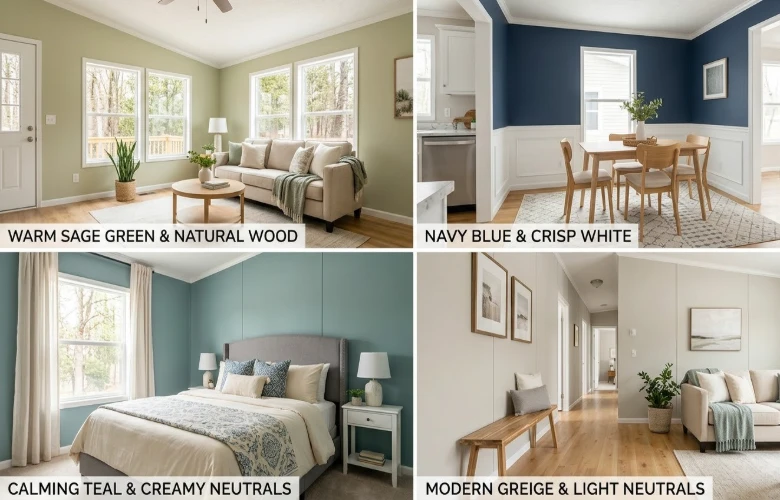
Color: Go Light on the Walls, Bold on the Accents
The colors are a bit lighter on the walls and a bit bolder on the accents.
In fact, painting is the most budget-friendly upgrade that can be done to a mobile home and it offers the greatest visual benefit.
Warm, light neutrals (soft white, warm beige, greige, pale taupe) will make walls recede and rooms feel airier. They reflect both light and man-made light. It is not strictly required that your home be sterile, either. Whites such as Benjamin Moore’s White Dove or Sherwin-Williams’ Accessible Beige are cozy and welcoming.
When the walls are neutral, it’s time to add color with accents, such as a throw pillow in a rusty tone, a rug in teal, a gallery wall with some intense prints. All the personality with none of the closed, suffocated wall experience.
Looking for an accent wall? Go for it. A darker wall behind the sofa or bed will give the room depth, but you will not overpower the room. Removable wallpaper is ideal here because it is renter-friendly, easy to change and comes in a variety of patterns and textures you’ll likely never need.
The flooring is one of the biggest impacts with one material throughout and it really makes a huge difference
Here’s a tip many mobile homeowners don’t know: When you have the exact same flooring over the entire house—or at least throughout the living area that is connected to the home—it really does make a space feel a lot larger.
If each room has a different flooring, your eye constantly shifts to the transitions and it will make the home look smaller in size. Adopt a single consistent floor and all of a sudden the whole layout is a continuous space.
Typically, luxury vinyl plank (LVP) is the best option. It looks like real wood, is more moisture resistant than real wood (especially important in kitchens and bathrooms), is more durable than real wood and can be installed over most existing subfloors. The LVP with a warm wood tone can make a world of difference in any home.
The first place to go if you’re working with a budget is the living room and the kitchen, as that is the largest bang for your buck of the two rooms.
A major drawback of mobile homes is that they often lack adequate lighting.One major disadvantage of mobile homes is that they are often poorly lit.
One of the easiest ways to identify a house that’s been untouched for a number of years is builder-grade fixtures. The upside is that swapping them out is also one of the cheapest upgrades available.
Inexpensive ceiling fixtures can be replaced with an inexpensive pendant or drum shade at most hardware stores for $50 to $150 per room or less and the difference is well worth it.
Consider the layering of light in addition to fixtures. One overhead light levelens a room and gives it a slightly institutional feel. Layer lighting for a reading nook, under cabinet lighting for the kitchen, or a bedside lamp — these will help to make all spaces feel more considered and warm!
Under-cabinet strip lights are an affordable option in the kitchen and can make a dramatic difference in changing the countertop workspace in a matter of seconds. A floor lamp has been placed in the living room by a chair, forming a nice corner setting which doesn’t look like it was just put together.
Furniture: scale and function over size
One of the most important things to consider when ordering furniture for your mobile home is the size of the furniture. The living room of a mobile home can fill up a showroom sofa completely.
Always measure before you purchase. In a one wide house, anything over 84 inches will probably take over the house. You can find apartment size or small furniture from most of the big furniture companies these days; it is not mini or “toy” furniture designed to fit in small areas.
Here, multi-functional pieces come into their own. The storage ottoman serves as a coffee table and hidden storage. A bed frame equipped with drawers will do away with a dresser altogether. A fold down table that attaches to the wall in the kitchen provides you your space for dining when and wherever it’s needed and gets tucked away when it’s not.
Legs on furniture have a better effect, than furniture that is flat against the floor; that space below the floor feels more open. Low level items also function well in rooms with lower ceilings as they draw the line in the direction of the ceiling, leaving the visual level lower.
To enhance an interior, simply add a mirror to any space
A properly placed mirror can increase the size of a room by almost double — and in mobile homes, with limited natural light, this can be of paramount importance.
Opposite a window, there is a large mirror that reflects light into the room. A full length mirror in a narrow hallway makes the length of a corridor seem more extensive than it is. For a small bedroom, these can be hung on the back of the closet door to create visual depth which doesn’t take up the floor space.
You don’t have to acquire designer rates to do this. IKEA or HomeGoods mirrors work just as well as the expensive ones! The key is location: where to fit them so they will catch and toss light, not into a corner where they only reflect a wall.
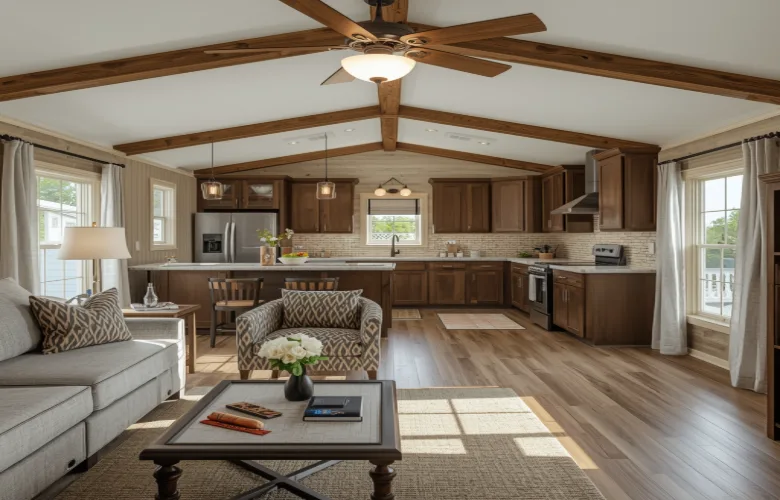
Room-by-Room Design Tips
Living Room
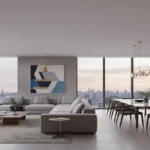
Minimalist seating is best—one or two accent chairs with a coffee table or ottoman. Don’t overcrowd every wall with furniture; it’s okay to have some space to breathe. A large piece of art above the sofa grounds the room and takes the eye to the ceiling, making it appear higher than it is.
In living/dining rooms, a large area rug is an easy solution to create a physical separation when the physical boundary is not wanted, but the visual is required.
Kitchen
With a few strategic improvements, even a compact kitchen can look modern and orderly. The easiest and most noticeable upgrade — replacing the brass cabinet pulls with matte black or brushed nickel requires less than an hour, and can be done for less than $50.
If you have very old cabinets but they are structurally sound, paint them. New cabinets with white or soft grey cabinets and new cabinet hardware can be the same as new cabinets for a much lower price.
Peel-and-stick tile backsplashes can be easily removed, inexpensive, and easy to place so most people will not know the difference between real tile and peel-and-stick tile backsplashes. Be sure to keep the counters free — and a clean kitchen always appears bigger and more costly.
Bedroom
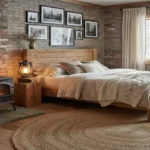
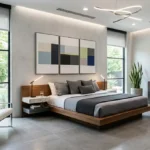
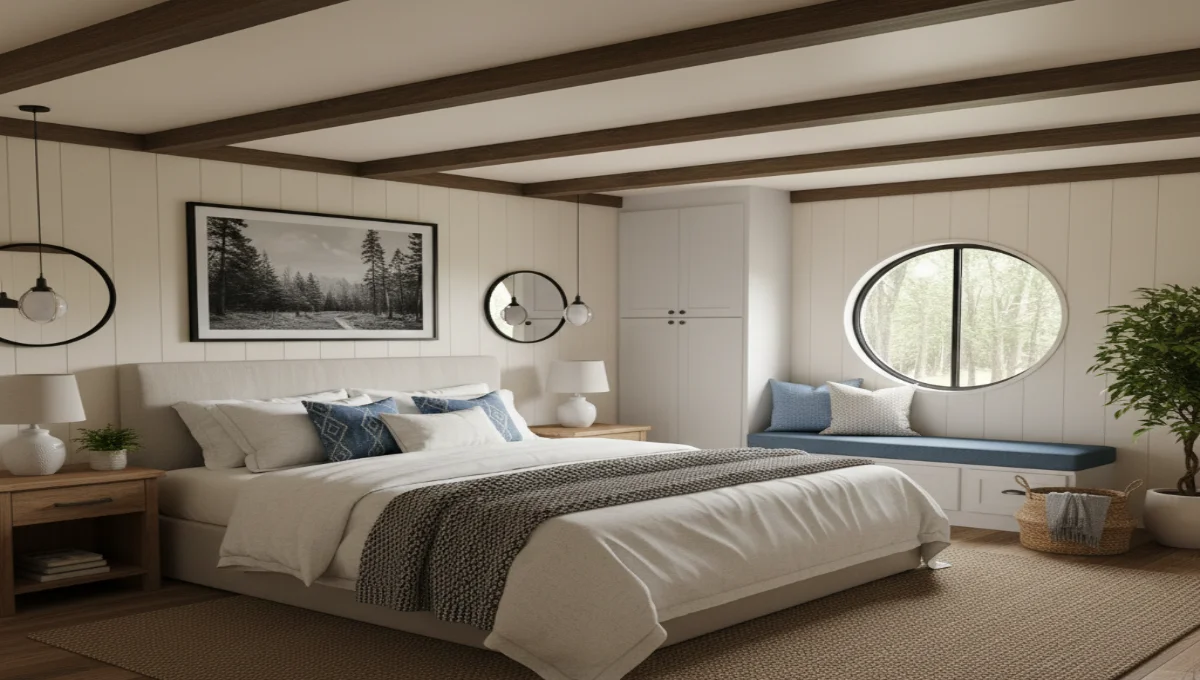
The bedroom should be a haven, relaxed and comfortable, and personal. Base on the bed as the starting point. Mobile home bedrooms lack a bed that’s covered in upholstery, but you can get a decent upholstery bed for under $200 that makes a huge difference in the room.
Simplify and stick to a uniform bedding. A well matched duvet in a warm neutral color, accented with one or two accent pillows is much more cohesive than a mismatched pattern mix. Having a small rug by the bed makes mornings a little easier.
Bathroom
Mobile home bathrooms are compact, but are very receptive to a few targeted improvements. Replace the toilet seat, the faucet and change the light fixture above the mirror — just three things that can be done for under $200 that will make a world of difference to the entire space.
A framed mirror will definitely look much better than a builder grade one. If you still have the old shower curtain, a new clean white or patterned curtain costs about $20 and will instantly give the bathroom a cleaner feel.
The following are popular interior design styles for mobile homes.The following are popular interior design styles for mobile homes.
Looking for some guidance? The following three styles are always successful in manufactured homes.
Mobile homes are in high demand, and Modern Farmhouse is the most sought-after option. A cozy, purposeful look without being overdone is created with Shiplap accent walls, open shelving, matte black hardware and warm neutral tones, which are well suited to the rectangular design that most mobile homes already have.
If you want lots of character and not much cash, you ought to go with a bohemian interior design. Layered rugs, rattan furniture, hanging plants and textured throws add warmth and interest without taking up any actual floor space. It’s also a forgiving style – there really is no such thing as too many plants, or too many throw pillows.
Japandi is a combination of Japanese minimalism and Scandinavian simplicity that is perfect for the mobile home concept, as it is all about small, well thought out spaces. Low furniture, natural wood tones, clean lines and a muted color scheme all contribute to a calm interior with a sense of spaciousness where it doesn’t necessarily exist.
When trying to transform your mobile home into a house, how do you do it?So, how do you make a mobile home look like a house?
This is likely the most frequent concern that mobile homeowners have and the answer is quite simple: there are only a few fixes.
Begin with the walls. This is the largest change you can make: Strip away old paneling, or prime the old paneling and paint it with the proper wall paint. With the walls one consistent neutral tone, the room instantly feels like an ordinary house.
Next, the floors. As discussed above, the running of LVP throughout the attached living space is one of the most significant things to give a mobile home the feel of a traditional home.
Next the light fixtures. It may seem a small thing, but swapping out those three rooms of old fixtures for new can cost less than $300, and totally transform the feel of the house.
Add trim next. Simple baseboards and door trim add to a room’s built-in look, and many mobile home kits lack such details. It is a weekend project that is made with materials that usually cost $1 to $2 per linear foot.
Last, but not least, introduce plants. Any room will be alive with real or faux greenery that looks good. Most furniture purchases pale in comparison to a large fiddlestick in a living room corner, or group of small potted plants on a kitchen windowsill.
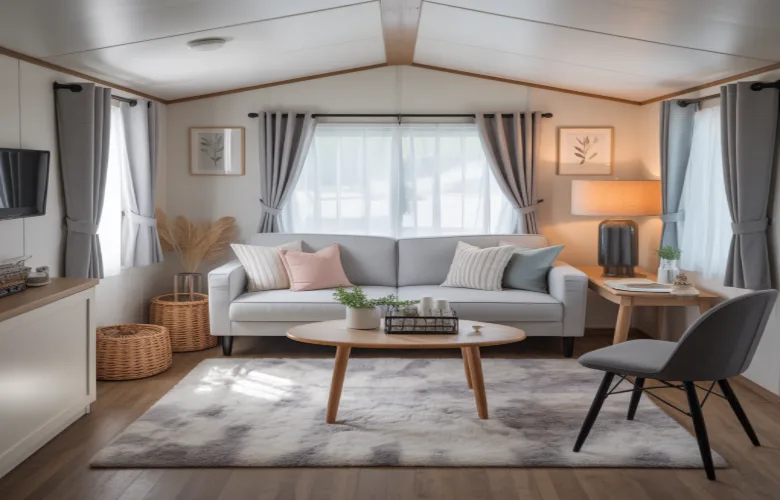
Trending Mobile Home Interior Design Styles in 2026
Mobile home design has moved way beyond basic. Homeowners across the USA are now embracing real interior styles — the same ones you’d find in any traditional house.
Modern Farmhouse remains the top pick for both single-wide and double-wide mobile homes. Shiplap walls, open shelving, and warm neutral tones give the space a cozy, put-together feel without feeling heavy or overdone. A simple barn-style door between rooms saves floor space and adds character.
Bohemian interior design works especially well in mobile homes because the style relies on layering textures and plants rather than big furniture pieces. Rattan chairs, macramé wall hangings, woven rugs, and hanging greenery all add warmth and personality without eating up your square footage.
Japandi a mix of Japanese minimalism and Scandinavian simplicity — is a smart direction if you want your mobile home to feel calm and uncluttered. Low-profile furniture, natural wood tones, and soft neutral walls do a lot of the heavy lifting in a smaller floor plan.
If you are also thinking about updating your kitchen during the renovation, it helps to plan both together — check out our guide on kitchen remodel cost to budget smartly from the start.
Professional Tips to Avoid Common Mistakes
Don’t buy furniture before measuring. This seems obvious, but it’s the most common and most expensive mistake in mobile home decorating. Measure every room before you shop, and write the dimensions down.
Don’t use too many different materials. Consistency creates cohesion. If your floors are a warm oak LVP, carry that warm tone into your furniture and accents. Mixing too many finishes and wood tones makes a small space feel chaotic.
Don’t neglect storage. Clutter is the fastest way to make a mobile home feel small. Invest in smart storage solutions — baskets, under-bed bins, drawer organizers, wall-mounted shelves — before you invest in decor.
Don’t skip the ceiling. A fresh coat of white paint on the ceiling brightens the whole space and makes it feel taller. It’s one of the most overlooked updates in mobile home design.
Mobile Home Interior Design Cost 2026
Before you start buying paint and furniture, it helps to know where your money actually goes. Costs vary a lot depending on whether you’re doing a light refresh or a full interior overhaul, and whether you’re working with a single-wide or double-wide.
Cosmetic Refresh: $500–$3,000
This covers paint, cabinet hardware, light fixtures, a backsplash, and a few area rugs — everything already covered in this guide. It’s the highest-return tier because the visual impact is huge relative to the cost, and most of it is doable over one or two weekends without hiring anyone.
Mid-Level Update: $3,000–$10,000
This is where flooring comes in. A full LVP install across the main living areas, new cabinet fronts instead of full replacement, and updated bathroom fixtures typically land in this range. A homeowner in Ocala, Florida remodeling a 900 sq ft single-wide should expect to land near the middle of this range for flooring plus kitchen hardware combined.
Full Interior Overhaul: $10,000–$30,000+
New cabinets, countertops, all-new flooring, wall paneling replacement, and updated trim throughout. Double-wide homes typically run 1.7–1.8x higher than single-wides at the same tier, simply because there’s more square footage to cover.
One thing worth knowing before you commit a big budget: cosmetic upgrades in the kitchen and bathroom tend to return more of their cost at resale than large structural interior changes. If resale value matters to you, prioritize paint, hardware, and flooring before you touch cabinetry layouts. For a deeper breakdown of designer-led project pricing, see our interior designer cost guide. (link this phrase to: https://interiordesigntrend.com/how-much-does-an-interior-designer-cost/)
Frequently Asked Questions
Q: What is the cheapest way to update a mobile home interior?
Paint is the highest-impact, lowest-cost update you can make. A fresh neutral wall color combined with new cabinet hardware and updated light fixtures can completely transform your space for under $500. After that, a consistent LVP floor throughout the main living areas is the next best investment for the money.
Q: What flooring works best in a mobile home?
Luxury vinyl plank (LVP) is the best option for most mobile homes. It handles moisture well, holds up to daily wear, installs easily over existing subfloors, and comes in styles that look nearly identical to real hardwood. Run it throughout connected living areas for the biggest visual impact.
Q: Can you make a mobile home look like a regular house?
Yes, absolutely. Paint the walls a warm neutral, update the flooring, replace light fixtures, add simple baseboards, and bring in some plants. These five changes alone will make your mobile home look and feel dramatically more like a traditional house — and none of them require major construction.
Q: What interior design style works best for mobile homes?
Modern Farmhouse, Bohemian, and Japandi all work exceptionally well in mobile homes. Each style is built around the idea of intentional, comfortable living in a well-used space — which is exactly what good mobile home design is about .
How much does it cost to redo a mobile home interior?
A cosmetic refresh (paint, hardware, lighting) runs $500–$3,000. A mid-level update with new flooring and cabinet fronts typically costs $3,000–$10,000. A full interior overhaul with new cabinets, countertops, and flooring throughout can run $10,000–$30,000 or more, with double-wides costing roughly 1.7–1.8x more than single-wides at the same tier