Last Updated on 6 months ago by
Nobody actually lives in a perfect home. The surfaces get worn. The paint chips. The wood darkens with age. The ceramic bowl develops a hairline crack from years of use.
Most design styles treat these things as problems to fix. Modern wabi sabi interior design treats them as the point.
This Japanese philosophy — one of the most quietly influential ideas in contemporary design right now — asks a genuinely different question than most approaches to decorating. Not “how do I make this look perfect?” but “how do I make this feel true?” The answer changes everything about how you choose materials, buy furniture, display objects, and think about the home you’re creating.
In 2026, modern wabi sabi interior design has moved from niche to mainstream across the USA — and for good reason. In a world saturated with fast furniture, perfect Instagram interiors, and the pressure to have everything look brand new, a philosophy that celebrates authenticity, age, and honest imperfection feels like a genuine relief.
This guide covers everything: the philosophy, the practical elements, room-by-room application, how to get the look on a real budget, and the mistakes that turn wabi sabi into something that just looks unfinished.
What Is Modern Wabi Sabi Interior Design?
The term combines two Japanese concepts with distinct but complementary meanings. “Wabi” originally described the solitude of living close to nature — a kind of poetic simplicity and humility, the beauty found in the humble and the unadorned. “Sabi” described the beauty of things as they age — the patina on old bronze, the fading of a lacquered surface, the way a wooden floor develops depth over decades of use.
Together, wabi sabi describes a worldview that accepts imperfection, impermanence, and incompleteness not as failures but as the natural and beautiful condition of all things. The cracked bowl isn’t broken — it’s honest. The weathered wood isn’t worn out — it’s earned its character. The asymmetrical vase isn’t wrong — it’s human.
Applied to interior design, modern wabi sabi creates spaces that feel genuinely calm, deeply grounded, and honestly personal. The materials are natural and imperfect. The palette is muted and earthy. The objects are handmade, aged, or both. The space breathes — negative space is treated as deliberately as any piece of furniture.
What it is not: unfinished, neglected, or randomly assembled. The most common misconception about wabi sabi is that it means doing less or caring less about the result. In reality, it requires more thoughtfulness than most design styles — because every element needs to be genuinely meaningful rather than simply decorative.
The Philosophy Behind the Aesthetic Why It Resonates So Strongly in 2026
Understanding why wabi sabi interior design has captured so much attention in recent years matters — because the answer reveals what the style is actually offering people.
The design world spent most of the 2010s celebrating perfection. Flawless white kitchens. Perfectly matched furniture. Spaces that looked like they’d never been touched. Social media amplified this tendency enormously — every room photographed at its theoretical best, presented as an aspirational standard.
The result, for many people, was a persistent sense that their actual home — where real life happens, where things get worn and chipped and rearranged and lived in — could never measure up.
Modern wabi sabi interior design offers a direct philosophical response to that pressure. It says the worn surface is more beautiful than the pristine one. The imperfect ceramic reveals the hand of its maker. The furniture that’s been used and loved for decades carries something that brand-new furniture never can. The home that looks genuinely lived-in is more honest — and more beautiful — than the one that looks like a showroom.
In 2026, with the slow living movement growing significantly across the USA, with more people prioritizing wellness and intentionality in their homes, and with widespread fatigue about fast furniture and disposable design, modern wabi sabi interior design meets a genuine and widespread need.
The 5 Core Principles of Wabi Sabi Interior Design
1. Kanso — Simplicity
Eliminate what doesn’t need to be there. Wabi sabi spaces are not minimalist in the architectural sense — they can contain objects, art, and layered textiles — but everything present has a genuine reason to be there. Objects that are purely decorative without any connection to the room’s purpose or the homeowner’s story are edited out.
This principle requires more discipline than it sounds. The instinct when creating a warm, layered interior is to add — another plant, another cushion, another object on the shelf. Kanso asks you to pause before adding and ask: does this belong? What does it contribute? Would the space be better without it?
2. Fukinsei — Asymmetry and Irregularity
Wabi sabi finds beauty in the uneven and the asymmetrical rather than in perfect symmetry and geometric precision. A vase that’s slightly irregular. An arrangement of objects that doesn’t balance perfectly. A throw draped casually rather than folded with mathematical precision.
This principle runs directly counter to most Western interior design conventions, which rely heavily on symmetry — matching bedside tables, centered artwork, balanced furniture arrangements — as a tool for creating visual harmony. Wabi sabi doesn’t reject harmony, but it finds it in a different way: through the natural balance of unlike things rather than through perfect mirroring.
3. Shibumi — Understated Beauty
Beauty that reveals itself slowly rather than announcing itself immediately. A surface whose texture becomes more interesting the longer you look at it. A material whose character deepens over years of use. A color that changes subtly in different light conditions.
Shibumi is the opposite of statement pieces and dramatic focal points. In a wabi sabi interior, the most beautiful things are often the quietest — the grain of a wooden table, the uneven glaze on a handmade bowl, the way afternoon light falls across a limewash wall.
4. Shizen — Naturalness
An authentic connection to the natural world expressed through materials, forms, and objects. Wood used because it’s wood, not despite its imperfections but because of them. Stone in its rough, unpolished state. Plants allowed to grow in their natural forms rather than being trimmed into geometric shapes. Natural light prioritized over artificial.
Shizen means choosing materials for their genuine character rather than for their uniformity. A plank of wood with a knot in it is more shizen than one that’s been processed to remove all variation.
. Datsuzoku — Freedom from Convention
Wabi sabi design doesn’t follow prescribed rules. It trusts the homeowner’s genuine response to objects, materials, and spaces over any external standard of correctness. If a cracked vase is beautiful to you, display it. If a piece of furniture doesn’t match but feels right, keep it. If a room doesn’t look like any magazine page but feels genuinely calm and personal, that’s the goal.
This principle is what makes wabi sabi both liberating and challenging — liberating because there are no rules to follow correctly, challenging because you have to develop and trust your own genuine aesthetic responses rather than deferring to an external standard.
The Wabi Sabi Material Palette
Natural Wood — Imperfect, Aged, and Honest
Wood in a wabi sabi interior is chosen for its character, not despite it. Live-edge tables with the natural bark intact. Reclaimed floorboards with visible nail holes and wear patterns from previous lives. A wooden bowl turned on a lathe where the natural variation in the grain creates a one-of-a-kind surface.
The finish matters as much as the wood itself. Oil finishes, wax finishes, and natural finishes that allow the wood to breathe and continue aging are ideal. Lacquer and polyurethane — which seal the wood behind a glossy layer that prevents further change — work against the wabi sabi philosophy.
In 2026, live edge furniture has become one of the clearest expressions of modern wabi sabi interior design in American homes. A live-edge dining table, coffee table, or floating shelf brings the organic edge of the original tree into the interior — an honest record of the material’s natural form.
Stone and Ceramics — Rough, Unpolished, Impermanent
Natural stone in its least processed state — travertine with visible fossils, slate with rough texture, limestone with natural variation — carries strong wabi sabi energy. Polished marble and precision-cut granite work against the philosophy, which prefers materials that show their natural character openly.
Ceramics are perhaps the single most important accessory category in wabi sabi design. Handmade pottery — with uneven walls, irregular glazing, and surfaces that reveal the finger marks of the maker — is the opposite of mass-produced uniformity. A single handmade ceramic vase, bowl, or cup carries more wabi sabi integrity than a shelf full of manufactured pieces in similar forms.
The Japanese art of kintsugi — repairing broken ceramics with gold lacquer, making the repaired crack more beautiful and visible rather than hiding it — is one of the purest expressions of wabi sabi philosophy. A kintsugi piece displayed in a wabi sabi interior isn’t just decorative: it’s a philosophical statement about the beauty of repair, imperfection, and the passage of time.
Linen, Wool, and Natural Fiber Textiles
Textiles in a wabi sabi interior should feel natural and slightly irregular — the texture of hand-woven linen rather than perfectly uniform cotton, the natural variation of undyed wool rather than precisely calibrated synthetic fabric.
Linen is the quintessential wabi sabi textile. Its natural tendency to wrinkle rather than lie perfectly flat, the slight unevenness of its weave, the way it softens and relaxes with washing — all of these are wabi sabi qualities. Linen curtains, linen bedding, and linen upholstery bring the right quality of imperfect naturalness into any room.
Undyed or naturally dyed textiles carry more wabi sabi integrity than synthetically colored ones. The muted, slightly unpredictable tones of natural dyes — indigo, walnut, iron oxide — align with the philosophy’s preference for materials that haven’t been processed into uniformity.
Woven grass mats, jute rugs, and seagrass flooring all reinforce the natural material palette at the floor level. Their texture is visible and tactile in a way that synthetic rugs are not.
Wabi Sabi Color Palette
The palette is narrow, muted, and drawn directly from the natural world. Not from the nature of saturated color — not the bright green of a tropical plant or the vivid blue of open sky — but from the more subdued tones of weathered surfaces, dry earth, aged wood, and quiet stone.
Foundation colors: warm white, warm cream, soft sand, pale clay, dusty taupe, warm mushroom gray
Accent tones: terracotta, dried clay red, aged ochre, moss green, dusty sage, dark charcoal, warm black
What to avoid completely: bright, saturated colors in any form. Cool grays. High-contrast black-and-white. Synthetic-looking tones that have no equivalent in the natural world.
The palette should feel as though it arrived naturally rather than being chosen — as though the colors accumulated through use and time rather than being selected from a chart.
Modern Wabi Sabi Interior Design Room by Room
Living Room
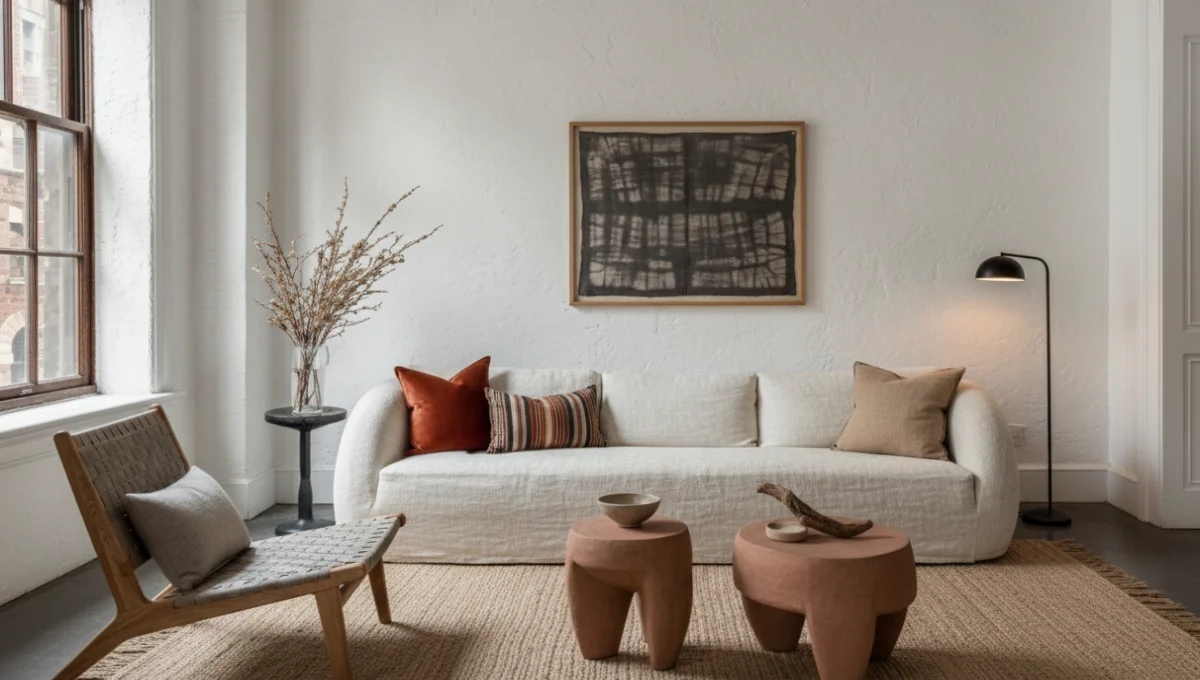
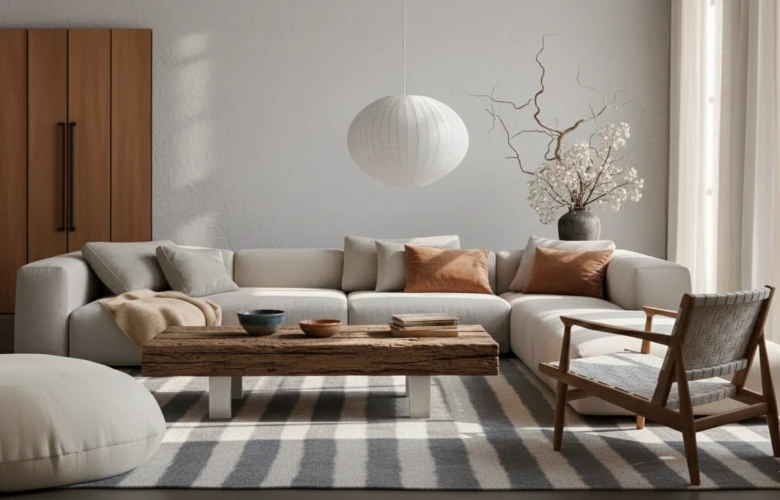
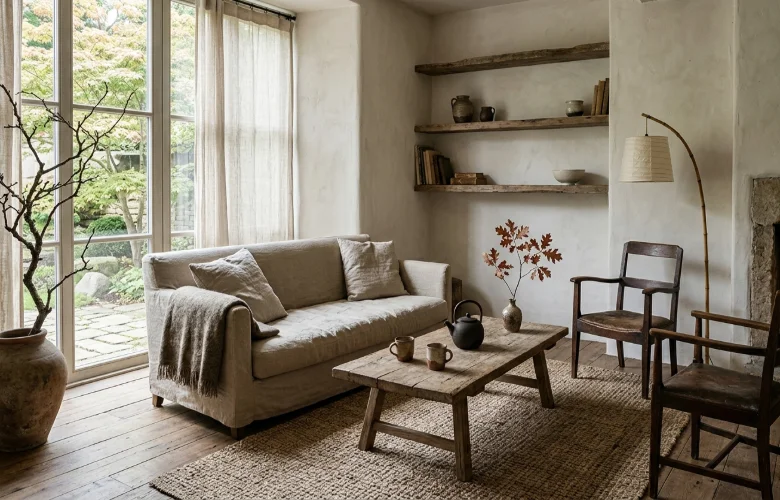
The wabi sabi living room is built around a few genuinely meaningful pieces rather than a full furniture suite. A single sofa with a natural linen or undyed cotton slipcover — the kind that wrinkles pleasingly rather than staying rigid — anchors the seating. A live-edge coffee table or a simple slab of natural stone on low legs serves as the surface the sofa organizes around.
One meaningful object on the coffee table: a handmade ceramic bowl, a smooth river stone, a small plant in an unglazed terra cotta pot. The surface should be largely clear — the space around the object matters as much as the object itself.
Wall treatment is one of the highest-impact wabi sabi decisions in a living room. Limewash paint — applied to create a softly uneven, aged surface — transforms a standard drywall room into something that feels genuinely old and honest. Natural plaster achieves a similar effect with more depth. Both options cost relatively little compared to wallpaper and produce a result that only gets more beautiful over time.
Art in a wabi sabi living room should be simple and natural — ink drawings, dried botanical prints, a simple textile hanging, or a single piece of handmade paper art. Avoid colorful statement pieces or highly complex compositions that demand constant attention.
Avoid: matching furniture sets, throw pillows in more than two closely related tones, coffee tables with glass tops or high-polish surfaces, and television units that dominate the room.
Bedroom
The wabi sabi bedroom is the room most naturally aligned with the philosophy’s core goals — rest, calm, and genuine comfort over performed perfection.
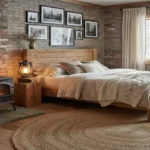
Bedding should be linen — the real, slightly rough, wrinkle-prone linen that gets softer with every wash rather than synthetic linen-look cotton that maintains its pressed appearance. In warm white, pale clay, or soft sage. Two or three layers at most: a fitted sheet, a flat sheet or light duvet, and a single textured throw at the foot. Remove all decorative pillows. The wabi sabi bed is one you actually sleep in, not one you remake every morning to a standard that makes you reluctant to use it.
The bed frame should be low and simple. A platform frame in solid wood — or even a floor-level futon frame in the Japanese tradition — keeps the room grounded and calm. Avoid upholstered headboards with buttons and stitching, metal frames with ornate details, or anything that competes for attention with the natural material palette.
One bedside surface on each side — a simple wooden stool, a single shelf, a small rattan table — with one object each: a handmade ceramic lamp or a small ceramic cup for water, a single book, nothing more.
Curtains in natural undyed linen that pool slightly on the floor, allowing morning light to filter through rather than blocking it completely. The movement of light through linen curtains is one of the most beautiful wabi sabi effects available in a bedroom — it changes throughout the day and with the seasons, making the room feel alive rather than static.
Kitchen
The wabi sabi kitchen runs counter to the polished, high-gloss kitchen aesthetic that dominated the 2010s. It’s quieter, more handmade, and more honest about the fact that kitchens are places where actual cooking happens.
Cabinetry in a wabi sabi kitchen is best in a flat-front style painted in a warm neutral — warm white, warm cream, or muted sage — with simple aged brass or raw iron hardware. The paint doesn’t need to be perfect. Minor variations and slight aging of the surface read as character rather than neglect.
Open shelving on at least one wall, displaying a curated collection of handmade ceramic pieces — bowls, cups, pitchers — in varying but related tones. These don’t need to match. An assortment of handmade pottery that accumulates over time, each piece slightly different, creates a genuinely wabi sabi display that manufactured matching sets cannot replicate.
Countertops in honed stone, concrete, or butcher block — materials that will show the evidence of use over time. A concrete countertop develops patina. A butcher block shows the history of chopping and cutting. Honed stone scratches slightly and becomes more interesting. All of these are wabi sabi outcomes.
The sink area benefits from a simple farmhouse-style ceramic sink — ideally in an off-white or slightly irregular glaze — with unlacquered brass faucets that will develop their own patina naturally over years of use.
Bathroom
The wabi sabi bathroom is one of the most transformative interpretations of the style — because bathrooms are typically the most aggressively sterile rooms in a home, and the wabi sabi response to that sterility is immediately striking.
Stone tile is ideal: travertine, slate, or rough limestone in a matte, honed finish. The variation in the stone’s pattern and color, the slight roughness of the unpolished surface, the way it changes when wet — all of these are wabi sabi qualities.
A wooden vanity — or a freestanding furniture piece repurposed as a vanity — brings the warmth of natural wood into a space that otherwise leans cold. A vessel sink in a handmade ceramic or unpolished stone adds the imperfection that manufactured sinks never have.
Unlacquered brass fixtures will develop patina naturally with use — the faucet that looked uniformly gold when installed will develop depth and variation over years of contact with water. This aging process is the opposite of a design problem in a wabi sabi bathroom. It’s the design.
Accessories should be kept to a minimum and chosen carefully: a wooden bath mat, a linen hand towel with visible texture, a single plant that thrives in humidity — a small fern, a trailing pothos, a peace lily — in an unglazed terra cotta pot.
Wabi Sabi vs. Minimalism — The Difference That Matters Most
This is the most common point of confusion for anyone new to modern wabi sabi interior design, and it’s worth addressing clearly.
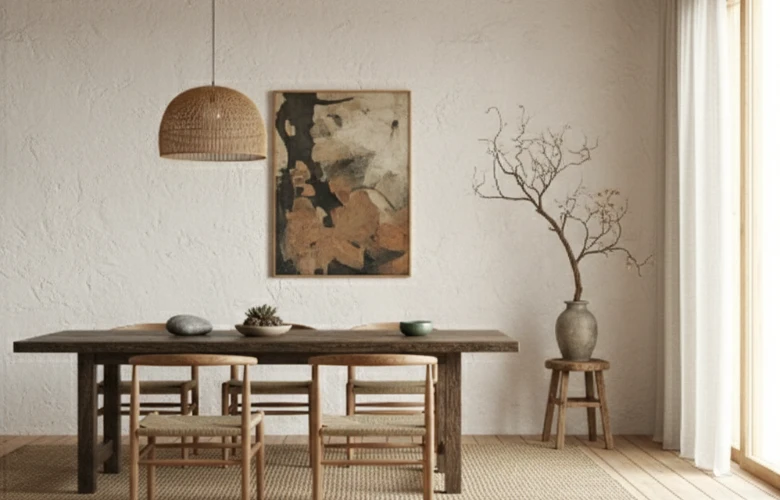
Both styles value simplicity, edited spaces, and quality over quantity. Both work with neutral palettes and natural materials. Both resist the accumulation of unnecessary objects.
The fundamental difference is this: minimalism pursues perfection through reduction. Wabi sabi pursues authenticity through acceptance of imperfection.
A minimalist interior has objects that are perfect — precisely manufactured, flawlessly finished, geometrically pure. A wabi sabi interior has objects that are honest — handmade, slightly irregular, aged in ways that show their history.
A minimalist space feels resolved, controlled, and precise. A wabi sabi space feels organic, evolving, and human.
Both are genuinely beautiful. But they offer different things — and understanding the difference helps you know which direction genuinely resonates with how you want to live.
How Wabi Sabi Compares to Related Styles
Wabi sabi vs. Japandi — Japandi blends Japanese minimalism with Scandinavian functionality. It shares wabi sabi’s love of natural materials and simple, uncluttered spaces, but is more polished, more precise, and more aligned with contemporary design conventions. Japandi tends toward cleaner lines and more refined finishes; wabi sabi embraces rougher textures and more visible imperfection. If you love feng shui home principles and the philosophy of intentional living, wabi sabi and Japandi both complement that approach well.
Wabi sabi vs. Rustic — Both styles value natural materials, aged surfaces, and the evidence of time. Rustic home aesthetics are warmer and more layered, with more furniture, more textile accumulation, and a stronger connection to specific cultural traditions like American farmhouse or European country living. Wabi sabi is quieter, more restrained, and more philosophical in its approach to imperfection.
Wabi sabi vs. Bohemian — Bohemian interior styling and wabi sabi share a love of handmade objects and an appreciation for things that carry history. But bohemian is layered, colorful, and eclectic — accumulation is part of the style. Wabi sabi is quieter, more restrained, and more monochromatic. The two share a spirit but express it in very different ways.
Wabi sabi vs. Modern — Modern interior design values precision, clean lines, and functional perfection. Wabi sabi values organic forms, imperfection, and the beauty of things that age. Modern design processes materials into uniformity; wabi sabi celebrates their natural variation. They can coexist in a single space — modern architecture with wabi sabi interiors — and the tension between them often produces particularly compelling results.
Modern Wabi Sabi Interior Design on a Budget
One of the most liberating aspects of this style is that it genuinely rewards buying less, buying older, and buying imperfect. It is one of the most naturally budget-friendly interior design styles available.
Thrift stores and estate sales are the most aligned shopping environments for wabi sabi. Old wooden furniture with genuine patina, handmade ceramic pieces at a fraction of retail prices, vintage linen textiles with natural aging — these are exactly what wabi sabi calls for, and they cost significantly less than new equivalents.
Limewash paint applied DIY to one or two walls costs $50 to $150 in materials and takes a weekend. The result — a softly aged, textured wall surface — is one of the most impactful wabi sabi transformations available at any price point.
Handmade ceramics from Etsy artisans range from $15 to $80 per piece and carry the genuine imperfection that wabi sabi calls for. Three or four handmade bowls and cups on an open kitchen shelf cost less than $200 total and immediately change the character of the space.
Unlacquered brass fixtures typically cost the same as standard fixtures — the difference is that they’re chosen for their tendency to age rather than despite it. This is a zero-additional-cost choice with a long-term aesthetic payoff.
Plants in unglazed terra cotta pots — the simplest and most affordable plants available at any garden center — cost $5 to $25 each and contribute exactly the natural, slightly imperfect quality that wabi sabi design calls for.
Wabi Sabi Mistakes That Make Spaces Look Wrong
Confusing wabi sabi with neglect. There’s a meaningful difference between a space that is intentionally imperfect and one that is simply unkept. Wabi sabi spaces are clean, thoughtfully arranged, and carefully edited. The imperfections are in the materials and the objects — not in the cleanliness of the space or the intentionality of its arrangement.
Buying “wabi sabi aesthetic” products from mass retailers. A manufactured rough-look ceramic from a big box store is not wabi sabi — it’s an imitation of wabi sabi that defeats the entire philosophy. The style calls for genuine handmade objects with genuine imperfection, not factory-produced approximations of handmade character.
Going too dark and gloomy. The earthy, muted palette of wabi sabi is warm and quiet — not dark and oppressive. A room in which every surface is deep gray or dark brown with no light sources or natural light doesn’t feel wabi sabi. It just feels heavy. Natural light, warm-toned artificial lighting, and pale foundation colors are essential.
Over-accessorizing with “Japanese-looking” objects. Wabi sabi is not a cultural theme. It doesn’t call for cherry blossom motifs, bamboo objects, or literal Japanese decorative items. It calls for honest, natural, imperfect objects from any cultural tradition that carry genuine character and age gracefully.
Forcing asymmetry artificially. Wabi sabi embraces natural asymmetry — the irregular edge of a handmade bowl, the uneven surface of a limewash wall, the natural drape of linen curtains. Deliberately mismatching things that would look better balanced, or deliberately choosing the more awkward arrangement, isn’t wabi sabi. It’s just imbalance.
How to Start: A Practical Wabi Sabi Transformation in 5 Steps
Step 1 — Declutter genuinely. Not tidy — actually remove. Everything that is manufactured to look perfect, everything that is purely decorative with no personal connection, everything that is broken or unused. Start with one room and be ruthless. Wabi sabi cannot begin until the space has been honestly edited.
Step 2 — Limewash one wall. Choose the most visible wall in your living room or bedroom. Apply limewash paint in a warm neutral — warm white, pale clay, or soft sand. The uneven application is the point. This single change transforms the character of a room more dramatically than almost any other intervention.
Step 3 — Replace three objects. Choose three objects currently in your main living area and replace them with handmade equivalents. A mass-produced vase → a handmade ceramic piece. A synthetic throw → a natural linen or wool blanket. A bought-as-a-set picture frame → a simple piece of original art or a dried botanical.
Step 4 — Add plants in terra cotta. Choose two or three plants that will grow naturally without being shaped — a trailing pothos, a simple succulent, a small fern. Place them in unglazed terra cotta pots. The natural aging of the terra cotta as moisture moves through it is a wabi sabi process in itself.
Step 5 — Change your lighting. Replace any cool-white bulbs with warm-toned equivalents in the 2700K range. Add a floor lamp or table lamp with a natural shade — linen or paper rather than synthetic. Reduce overhead lighting usage in the evening. The way a wabi sabi room looks in warm lamplight at dusk is often its most compelling moment.
Frequently Asked Questions
Q: What is modern wabi sabi interior design in simple terms?
Modern wabi sabi interior design is a Japanese-influenced approach to decorating that finds beauty in natural materials, imperfection, and the honest aging of objects over time. It values handmade objects over manufactured ones, natural imperfection over manufactured uniformity, and the calm of a thoughtfully edited space over the stimulation of a heavily decorated one. In 2026, it’s one of the most widely influential design philosophies in American residential interiors.
Q: Is wabi sabi the same as minimalism?
No — though the two styles overlap significantly. Both value edited, uncluttered spaces and natural materials. The key difference is philosophical: minimalism pursues perfection through precise reduction, while wabi sabi pursues authenticity through the acceptance of imperfection. A minimalist space has objects that are perfect; a wabi sabi space has objects that are honest. Minimalism resolves a room into geometric precision; wabi sabi allows a room to remain organic and imperfect.
Q: How do I incorporate wabi sabi design on a tight budget?
Wabi sabi is genuinely one of the most budget-friendly design styles available because it rewards buying older, buying less, and buying imperfect. Thrift stores and estate sales are ideal sources for handmade ceramic pieces, aged wooden furniture, and vintage textiles at low prices. Limewash paint applied DIY creates a significant transformation for under $150. Plants in unglazed terra cotta pots cost almost nothing. The philosophy actively discourages buying new manufactured products — which makes it naturally economical.
Q: What colors are used in wabi sabi interior design?
The palette stays muted, warm, and earthly throughout. Foundation colors include warm white, warm cream, soft sand, pale clay, and dusty taupe. Accent tones include terracotta, aged ochre, moss green, dusty sage, and warm charcoal. The palette should feel as though it arrived naturally rather than being chosen — derived from weathered surfaces, dry earth, aged wood, and quiet stone rather than from a paint chip chart.
Q: What is the difference between wabi sabi and Japandi?
Both styles are Japanese-influenced, minimalist, and natural-material-focused. Japandi blends Japanese minimalism with Scandinavian functionality, resulting in spaces that are clean, precise, and modern. Wabi sabi is less concerned with precision or modernity — it embraces rougher textures, more visible imperfection, and the beauty of things that age and weather. Japandi is more polished; wabi sabi is more organic.
Conclusion