Last Updated on 5 months ago by
You just received a quotation from an interior designer. It’s three pages long, has line items you don’t recognize, and the total is higher than you expected. Now what?
Or maybe you’re a designer who just lost a project you should have won, and you suspect your quotation had something to do with it.
Either way, understanding how an interior design quotation actually works — what belongs in it, how the numbers are built, and what separates a professional document from a problematic one — makes a real difference in how projects start, run, and finish.
This guide covers both sides of the table. Clients get a clear picture of what they’re looking at and what to question. Designers get a practical framework for writing quotations that win work and protect their business.
What an Interior Design Quotation Actually Is
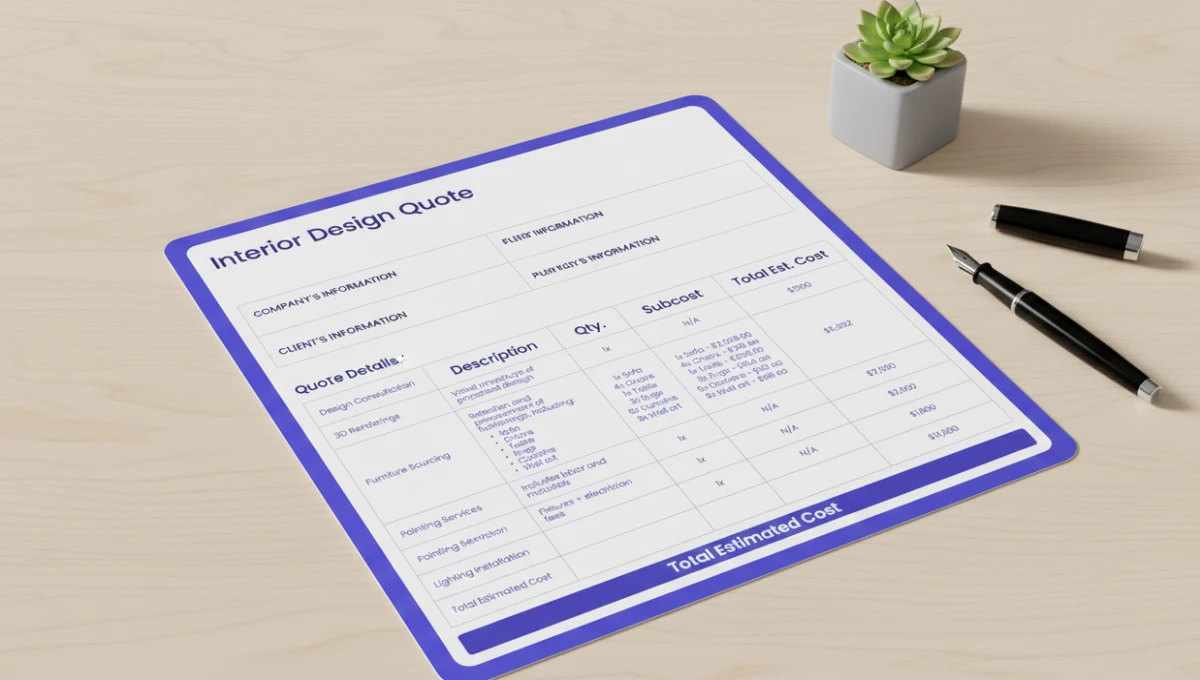
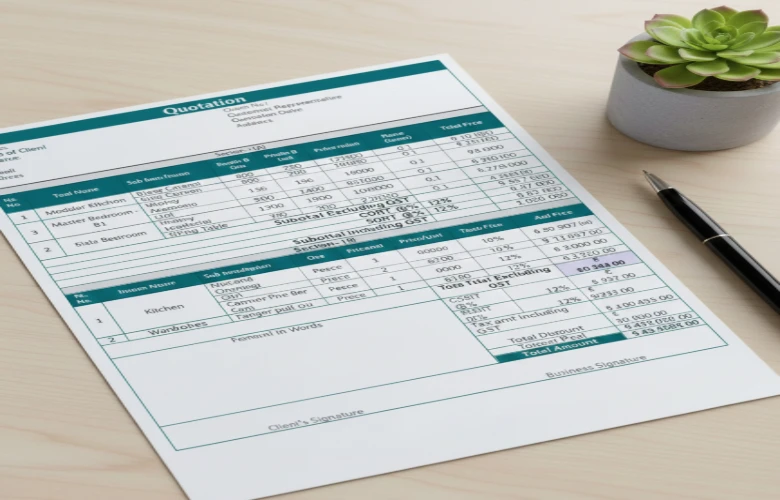
An interior design quotation is a formal pricing document that breaks a project down into individual cost components. Design fees. Furniture. Lighting. Materials. Contractor coordination. Each item listed separately with its own price so the client can see exactly where the money goes.
It’s not a contract. That’s a common misconception worth clearing up early. A quotation is a pricing proposal. A separate design agreement or letter of engagement creates the legal relationship. But in practice, the quotation is often the document that determines whether a client moves forward — because it’s the first real signal of how organized and transparent a designer’s business operation is.
The distinction between a quotation and a few related terms also matters. A design estimate is approximate — a range based on limited information, usually provided before a full site assessment. A design proposal is broader, often including concept direction and project approach alongside pricing. An interior design quotation sits between these: specific enough to serve as a real pricing commitment, detailed enough to define scope, but not yet the formal agreement that governs the project.
What Every Quotation Should Include
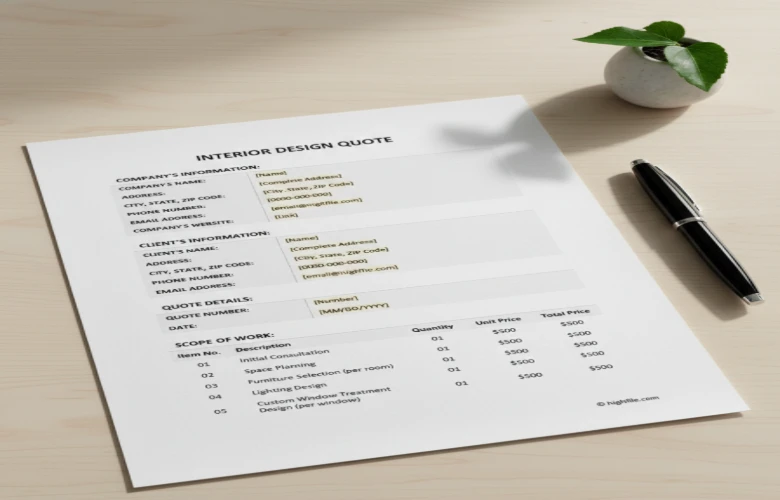
A professional interior design quotation has specific components. If any of these are missing from a quote you’ve received, it’s worth asking why.
Client and firm information. Full legal names, addresses, and contact details for both parties. This sounds obvious, but missing or incomplete contact information on a formal document is a signal worth paying attention to.
Quotation date and validity window. Material prices and product availability change. Most professional quotations in the USA specify a validity period of 30 to 90 days. After that window, the designer may need to reprice items. If there’s no validity date on a quotation, ask when the prices expire.
Scope of work. This is the most important section and the one most commonly written too vaguely. A strong scope of work specifies exactly which rooms are included, which design phases are covered — concept development, design development, procurement, installation oversight — and what is explicitly excluded. Vague scope language is the most common source of client-designer disputes.
Itemized line items. Every service and product listed individually with its own cost. Design fees, furniture, lighting, textiles, window treatments, and accessories should each appear as distinct entries. A quotation that lumps everything into a single total or into a handful of broad categories is not giving you the information you need to make an informed decision.
Fee structure. How the designer charges — hourly, flat fee, percentage of total project cost, or some combination — should be explained clearly. If a retainer is required to begin work, the amount and how it applies to the total should be stated.
Markup disclosure. Designers who source products for clients typically mark up those products above the trade price they pay. In the USA, professional standards require this to be disclosed. The markup percentage should appear in the quotation. Industry standard runs from 15% to 35% above trade cost depending on the designer and market.
Payment schedule. When payments are due and what percentage is required at each stage.
Exclusions. What’s not covered matters as much as what is. Permit fees, contractor labor, structural work, moving services, and items the client sources independently should be listed explicitly as exclusions.
Acceptance line. A signature block for both parties to confirm the client has reviewed and accepted the quoted scope and pricing.
How Interior Designers Build Their Fees
Understanding the fee structures designers use makes a quotation much easier to read. In 2026, the four most common approaches in USA residential and commercial design are:
Hourly billing suits smaller projects and consultations. Rates across the country range from $75 to $500 per hour. In New York City and Los Angeles, senior designers regularly bill $250 to $500 per hour. In markets like Nashville, Austin, and Denver, $100 to $200 per hour is more typical. Hourly billing is transparent but can feel unpredictable for clients who want to know total cost upfront.
Flat fee pricing gives clients a fixed number for a defined scope of work. This is increasingly the preferred structure for residential projects because it removes uncertainty for both parties. A single-room redesign flat fee typically runs $1,500 to $5,000. A full-home project flat fee varies enormously based on home size and project complexity, but $15,000 to $50,000 covers most mid-range residential projects outside major metro areas.
Percentage of project cost is common in larger residential renovations and commercial projects. The designer charges 10% to 30% of the total project budget including furniture, materials, and contractor costs. This model aligns incentives but means the designer’s fee grows as the project budget grows, which some clients find uncomfortable.
Hybrid models combine a design fee for services with product markup on items sourced through trade accounts. A designer might charge a modest flat fee for design work and then mark up furniture and materials 20% to 25% above their trade cost. This is one of the most common structures in residential design and perfectly legitimate when disclosed clearly.
| Fee Structure | Best For | Typical Range |
|---|---|---|
| Hourly | Consultations, small projects | $75 to $500/hr |
| Flat fee | Single rooms, defined scope | $1,500 to $50,000+ |
| Percentage | Large renovations, commercial | 10% to 30% of budget |
| Hybrid | Mid-size residential | Design fee + 15-35% markup |
Real Interior Design Quotation Costs by Project Type
What does a complete interior design quotation actually look like in dollar terms? Here’s what clients in the USA are realistically spending in 2026:
| Project Type | Design Fees | Total Project Budget |
|---|---|---|
| Single room consultation | $300 to $800 | $400 to $900 |
| Single room full design | $1,500 to $5,000 | $8,000 to $30,000 |
| Apartment redesign | $5,000 to $15,000 | $30,000 to $100,000 |
| Full home renovation | $15,000 to $60,000 | $100,000 to $500,000+ |
| Commercial office space | $10,000 to $75,000 | $50,000 to $500,000+ |
| Dental or medical office | $15,000 to $75,000 | $150,000 to $800,000 |
Location has a significant effect. A mid-range residential redesign that costs $40,000 in Chicago or Dallas might run $65,000 to $85,000 for the same scope in Manhattan or San Francisco. If you want to understand how professional designers price their services in your specific market, our guide on what interior designers charge breaks this down by city.
Red Flags in an Interior Design Quotation
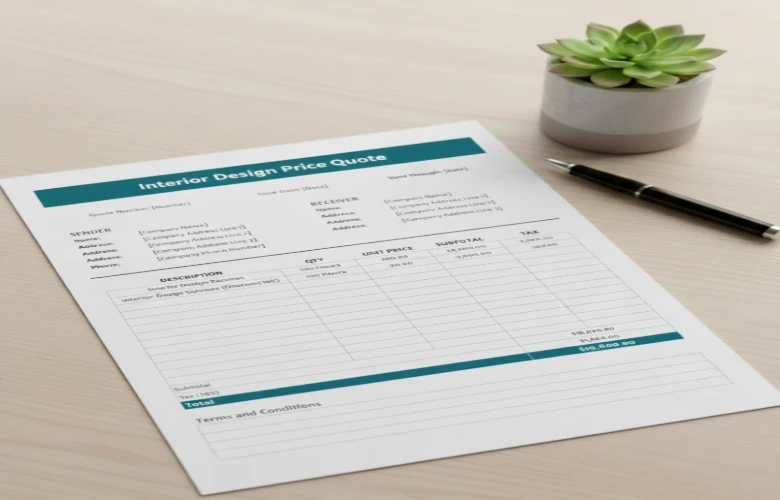
Some things in a quotation should prompt questions before you sign anything. These aren’t necessarily dealbreakers, but they’re worth addressing directly.
No itemization. A quotation that shows a single lump sum or just a few broad categories doesn’t give you enough information. Ask for a full itemized breakdown before proceeding.
No scope of work. Pricing without a clear description of what’s being delivered is essentially meaningless. If disputes arise later, there’s nothing to refer back to.
No markup disclosure. If a designer sources products for you and there’s no mention of markup in the quotation, ask specifically how they handle trade pricing and what percentage they add. Responsible designers disclose this proactively.
No exclusions list. Assuming everything is included is how projects go over budget. Make sure the quotation explicitly states what isn’t covered.
Unrealistically low pricing. A quotation that comes in dramatically below others you’ve received deserves scrutiny. Either the scope is narrower than you think, the quality of products and materials is lower, or the designer is inexperienced with project costs. All three situations create problems mid-project.
No validity date. Without a pricing validity window, you don’t know how long these numbers hold. Material costs and product availability shift regularly, particularly for custom furniture and specialty tile.
Vague payment terms. “Payment due upon completion” is not a payment schedule. A professional quotation specifies deposit amounts, milestone payments, and final payment timing.
How to Write a Strong Interior Design Quotation
For designers reading this, the quotation you send is often the first detailed document a prospective client sees from your business. It shapes their perception of your professionalism before the project starts.
A few principles that separate quotations that win projects from ones that don’t:
Write the scope of work as if a stranger needs to execute it. If someone who wasn’t part of your initial conversation had to read your scope description and understand exactly what you’re doing, could they? If not, it needs more specificity.
Use plain language for line item descriptions. “Living Room: Custom Sofa — Maker’s Mark Studio, Biscuit Linen, 96in — Lead time 10-12 weeks” is more useful than “Living Room Furniture.” Clients remember what they agreed to when the description is specific enough to picture.
Disclose everything that could become a question later. Markup, exclusions, payment timing, change order policy, what happens if a product is discontinued — addressing these proactively in the quotation prevents uncomfortable conversations mid-project.
Format matters. A well-organized quotation in a consistent template with your firm’s branding reads as more professional than a Word document reformatted on the fly. Software tools like Mydoma Studio, Studio Designer, and Design Manager all produce professional interior design quotations with consistent formatting and automatic calculations.
State your change order policy. If a client adds rooms, changes products, or expands scope after the quotation is accepted, how does that get priced and billed? This should be in the quotation, not a surprise when it happens.
Interior Design Quotation Software Worth Knowing
Most designers working at scale no longer build quotations manually in Word or Excel. Dedicated software handles calculations, product libraries, and client presentation more efficiently.
Mydoma Studio is one of the most widely used platforms among USA residential designers. It manages quotations, proposals, client communication, and product sourcing in one system. Pricing starts around $49 per month.
Studio Designer is more commonly used by larger firms and commercial practices. It handles project accounting, vendor purchasing, and client billing alongside quotation generation.
Design Manager is a comprehensive practice management tool with strong quotation and procurement features, popular among mid-to-large residential firms.
Houzz Pro includes quotation tools alongside project management, client communication, and a product catalog, making it a practical all-in-one option for designers who also use Houzz for marketing.
For freelance designers and those just starting out, a well-formatted Google Sheets or Excel template with locked formulas and consistent branding handles quotation basics perfectly well until project volume justifies dedicated software.
What Clients Should Do Before Accepting a Quotation
Get at least two quotations for any project over $10,000. Not to find the lowest price, but to understand the range of approaches and what different designers include or exclude for similar money.
Read the scope of work carefully before looking at the total. The numbers only make sense in the context of what’s being delivered.
Ask about the contingency budget. Renovation projects in particular regularly encounter unexpected conditions — concealed water damage, outdated wiring, discontinued products. A designer who builds a 15% to 20% contingency into their project budget recommendation is being realistic. One who doesn’t is setting you up for a surprise.
Understand the payment schedule completely before signing. Know exactly when money is due and what triggers each payment. If a $5,000 deposit is due to begin work and the next payment isn’t due until installation, make sure you’re comfortable with that timing.
Ask what happens if you want to make changes after the quotation is accepted. A clear change order policy protects both parties and prevents the conversation from becoming awkward when it inevitably comes up.
If you’re also getting quotes for the physical renovation work alongside the design services, understanding typical kitchen remodel costs or paint costs per square foot helps you evaluate whether the contractor pricing your designer has included is reasonable.
.
A quotation tells you the starting number. For a clearer picture of what interior design projects cost from start to finish, that guide walks through real budgets across every room type.
FAQ Section
So what is the interior design quote?
An interior design quote is one that is creative and has a purpose, like in the case of Design is not decoration, it is intention.
What is the 70 30 rule of interior design?
The 70/30 rule implies balancing 70 percent of a dominant element or color to 30 percent of another one.
What does it mean to do a quotation of interior design?
In order to develop a quotation regarding the interior design, one is to measure the space, determine the scope, specify materials, estimate labor, and add design charges, as well as to provide schedules.
What is the 3 5 7 rule of interior design?
The 3- 5 7 rule aids in bringing out visual balance through odd number groupings of the decor items.
Q: Why is an interior design quote important before starting a project?
An interior design quote is a document that is detailed and in which the approximate price of an interior design work is revealed.
It involves design services, materials, labor expenses, schedules, and terms of payment.
Quations are not done as an approximate one but after knowing what the client needs, area of space and what the design entails.
A quotation gives a clear understanding of what needs to be done between the designer and the client.
It serves as a point of reference document during the lifecycle of the project.
The quotation should be transparent to create a trust in professional interior design services.
Quotations are usually used in residential, office, retail, and commercial interior design projects.
A quote should be prepared to prevent miscommunication when it is carried out.
It secures the client and the designer both legally and financially.
Q: What is the importance of a home interior design quote?
A: It makes you know the expenses, no secret charges, and budget on the interior design project before you begin it.
Q: What is the duration that I should wait to be able to follow up on a sent quotation?
A: In most cases, wait a period of 3-5 business days and go on to send a polite follow-up.
Checklist Interior design quote checklist.
- Before finalizing:
- Scope defined
- Materials listed
- Costs itemized
- Timeline included
- Payment terms clear
- This checklist will guarantee professional interior design quotation.
Conclusion
An interior design quotation is well prepared to make a successful interior project. It introduces clarity, establishes trust and assists in the handling of expectations between the clients and the designers.
When planning to do a small makeover of a room or a complete interior designing project, you can be confident in what you decide to do as long as you know quotations. Effective communication via a comprehensive quotation provides more positive outcomes, ease of implementation, and satisfaction in the long-term.