Last Updated on 5 months ago by
The Victorian era lasted from 1837 to 1901. Its design influence has never really left.
Walk into any home in cities like San Francisco, Boston, Chicago, or New York with its original architectural bones intact and you understand why. Tall ceilings. Bay windows. Ornate crown molding. Deep fireplace surrounds. These spaces carry a weight and permanence that most contemporary construction simply cannot replicate. Modern Victorian interior design takes those bones and figures out how to live in them like it’s actually 2026 rather than 1887.
The result is one of the most compelling design directions in American homes right now. Not the stuffy, museum-quality Victorian reproduction that makes a room feel like a historical diorama. Not the cold contemporary interior that ignores everything its architecture is offering. Something deliberately in between — rich, layered, moody, and deeply personal, with the intelligence to know which Victorian elements to keep, which to modernize, and which to leave behind entirely.
What Modern Victorian Interior Design Actually Means
The term gets used for several different aesthetics. Being precise helps.
Modern Victorian interior design is not about recreating a Victorian home accurately. It’s about taking the best qualities of Victorian design philosophy — the richness, the layering, the willingness to use strong color, the appreciation for craftsmanship and detail — and expressing them in ways that suit contemporary life.
Victorian interiors were characterized by strong color, pattern everywhere, rich textiles, dark wood furniture, ornate architectural details, and a general philosophy that an undecorated room indicated a lack of taste. The wealthy middle class of the Industrial Revolution era used their homes to display everything they had accumulated — objects, patterns, textiles, art — and the resulting interiors were layered to a degree that contemporary sensibilities would call overwhelming.
Modern Victorian interior design selects from that vocabulary deliberately. The jewel tones without every wall in a different saturated color. The velvet and damask without the full suffocating textile accumulation. The ornate moldings without every surface carved and gilded. The dark, moody atmosphere without the literal darkness of inadequate lighting. What’s left is a style that feels rich, authoritative, and genuinely elegant rather than merely busy.
The 80/20 rule applies consistently to successful modern Victorian interiors: roughly 80% modern furniture paired with 20% antique or period-inspired accents, or vice versa. This balance prevents the room from feeling like a museum exhibit while maintaining the historical richness that defines the style. Interiordesigntrend
The Core Elements of Modern Victorian Interior Design
1. Color: Dark, Moody, and Unapologetically Rich
Color is the single fastest way to establish a modern Victorian interior, and the 2026 version of the palette is significantly more confident than the muted, safe directions that dominated the previous decade.
Deep, saturated colors like burgundy, forest green, and chocolate brown are replacing cool grays in modern Victorian spaces, creating moody palettes that highlight intricate molding more effectively than white ever could. Interiordesigntrend
The jewel tone palette that defines modern Victorian design in 2026:
- Emerald and forest green on walls or in large upholstered pieces. Farrow and Ball Calke Green No. 80, Sherwin-Williams Rookwood Dark Green SW 2809, and Benjamin Moore Hunter Green 2041-10 all deliver the right depth.
- Deep burgundy and wine in textiles and accent walls. Sherwin-Williams Antique Red SW 0006, Benjamin Moore Merlot Red 2006-10.
- Midnight navy and deep teal as wall colors in bedrooms and studies. Farrow and Ball Hague Blue No. 30, Benjamin Moore Van Deusen Blue HC-156.
- Rich chocolate brown and warm black in millwork, cabinetry, and furniture. Sherwin-Williams Caviar SW 6990, Farrow and Ball Off-Black No. 57.
- Antique gold and aged brass as metallic accents throughout. These reference Victorian opulence without requiring literal gold leaf.
The 2026 approach to these colors is more restrained than the full-room saturated Victorian approach. One deeply colored wall in a room with otherwise neutral or lighter surfaces, or a single large piece of furniture in a rich jewel tone against neutral walls, delivers the modern Victorian impact without the visual heaviness of an all-over deep color scheme.
2. Architectural Details: The Style’s Most Powerful Asset
If your home has original Victorian architectural features, they are your most valuable design asset. Crown molding, ceiling roses, wainscoting, chair rails, bay windows, decorative fireplace surrounds, and high ceilings define the visual language of Victorian architecture. Working with them rather than around them is what separates a genuinely successful modern Victorian interior from one that just has dark walls and velvet furniture.
The most effective approach is to let the architectural details define the room’s character and keep the furnishings relatively restrained. Built-in shelves flanking a fireplace bring Victorian architecture front and center, while the styling keeps the room light and current by using a neutral palette that lets the architectural details and brick interior read clearly.
For homes without original Victorian architecture — the majority of American homes, which were built after 1950 — architectural elements can be added selectively. Installing crown molding costs $3 to $12 per linear foot professionally installed. Wainscoting in a dining room or hallway costs $7 to $20 per linear foot depending on the profile complexity. A decorative fireplace surround with a period-appropriate mantel, even in a room where the fireplace is purely decorative, anchors the Victorian character of a space at relatively modest cost.
Picture rail molding — the horizontal rail that runs just below the ceiling from which Victorian homeowners hung their artwork — is one of the most authentic and most achievable Victorian architectural additions. It typically costs $2 to $6 per linear foot in materials and allows art to be hung and repositioned without damaging walls.
3. Rich Textiles: Velvet, Damask, and Layered Pattern
The Victorians adored textiles — sumptuous velvets, intricate damasks, and flowing silks were the lifeblood of the home. This love for tactile richness is a cornerstone of Victorian interior design. Interiordesigntrend
In a modern Victorian context, this translates to:
Velvet on sofas, armchairs, and dining chairs in deep jewel tones. Forest green velvet, deep burgundy velvet, and midnight navy velvet are the most widely used upholstery choices in modern Victorian living rooms and dining rooms in 2026. Performance velvet options from brands including Crypton and Revolution are available through retailers like Wayfair, Interior Define, and local upholsterers, making the aesthetic accessible even in homes with children or pets.
Patterned wallpaper on at least one wall — the wall behind the bed, the dining room, a home office. Botanical prints, damask patterns, and dark floral wallpapers are all period-appropriate. Cole and Son, Schumacher, Phillip Jeffries, and Graham and Brown all produce wallpaper collections that work in modern Victorian contexts across a range of price points.
Heavy drapes in rich fabrics — velvet, linen-velvet blends, jacquard, or heavy cotton — hung high and extending to the floor. Ceiling-mounted rods that allow drapes to hang from just below the crown molding to the floor emphasize the room’s height and create the theatrical quality that Victorian design valued.
Layered rugs in Persian, Turkish, or Moroccan patterns with rich, deep color palettes. These reference the Victorian practice of covering floors entirely in pattern and provide acoustic softening in rooms with hard floors.
4. Dark Wood and Period-Appropriate Furniture
Victorian furniture is characterized by dark wood in walnut, mahogany, and ebonized finishes with carved details, cabriole legs, and substantial proportions. In a modern Victorian context, genuine antique pieces are ideal — but mixing them with contemporary furniture is both acceptable and often preferable.
The successful modern Victorian approach pairs contemporary lighting as a secret weapon. Sculptural brass and glass fixtures hanging below ornate plaster medallions create a contrast that makes the traditional architectural details stand out while keeping the mood light and current rather than heavy and dated. Interiordesigntrend
Where to source appropriate furniture:
- Chairish and 1stDibs for genuine Victorian and Edwardian antique pieces in the USA
- Restoration Hardware for contemporary furniture with the right scale and material quality for Victorian contexts
- Anthropologie for accessible pieces with Victorian-influenced details
- Local antique markets in cities like New York, Chicago, New Orleans, and San Francisco where Victorian furniture is widely available
5. Statement Lighting: The Modern Victorian’s Most Important Update
Victorian homes were lit by gas and candlelight before electricity. The approach to artificial lighting in those interiors — multiple sources, warm quality, theatrical effect — translates directly and powerfully into contemporary lighting design.
Chandeliers with crystal or glass are the most iconic Victorian lighting fixture. In a modern Victorian context, the scale and proportion of the chandelier matters enormously. A fixture that’s too small for the room looks decorative. One that’s appropriately scaled — typically 1 inch of chandelier diameter for every foot of room width — looks like it belongs there.
Wall sconces on either side of a fireplace, at the ends of hallways, and flanking beds or mirrors reinforce the layered lighting approach that Victorian interiors used by necessity. Brass, bronze, and antique gold finishes on fixtures are consistent with the style’s metallic palette.
Contemporary pendant lights over dining tables — even sculptural, clearly modern designs — work beautifully in modern Victorian dining rooms because the contrast between modern fixture and traditional architecture reads as intentional rather than accidental. This is one of the clearest expressions of the modern Victorian philosophy: the new and the old speaking to each other rather than competing.
Modern Victorian Interior Design Room by Room
Living Room
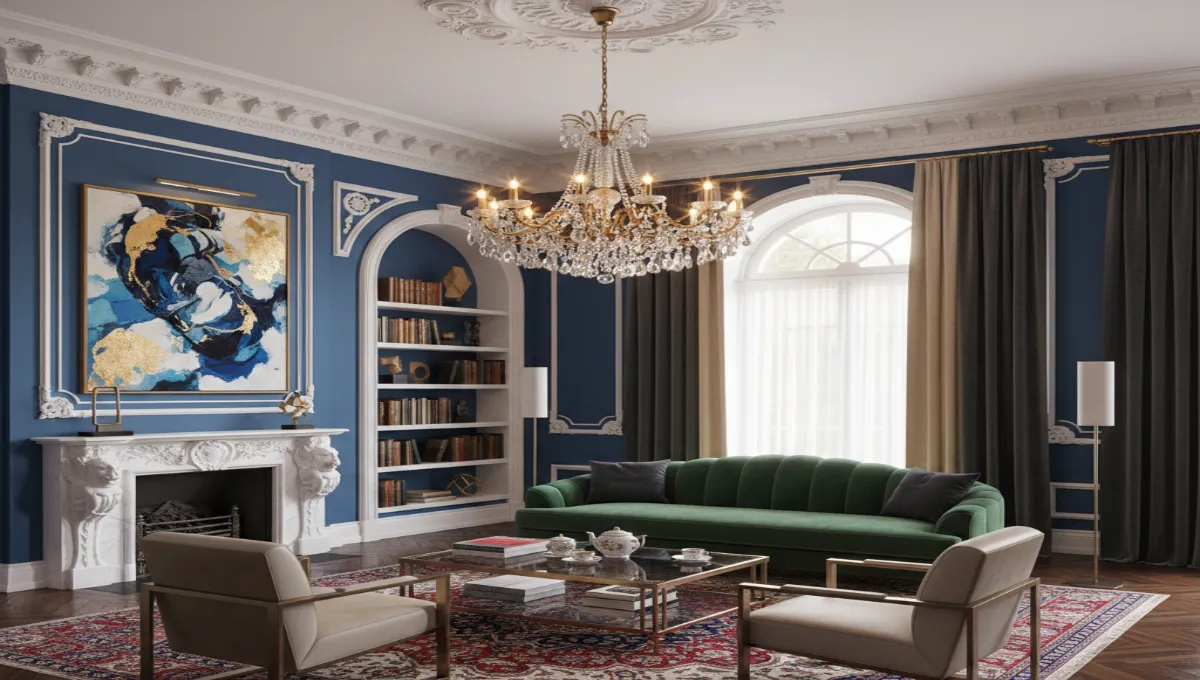
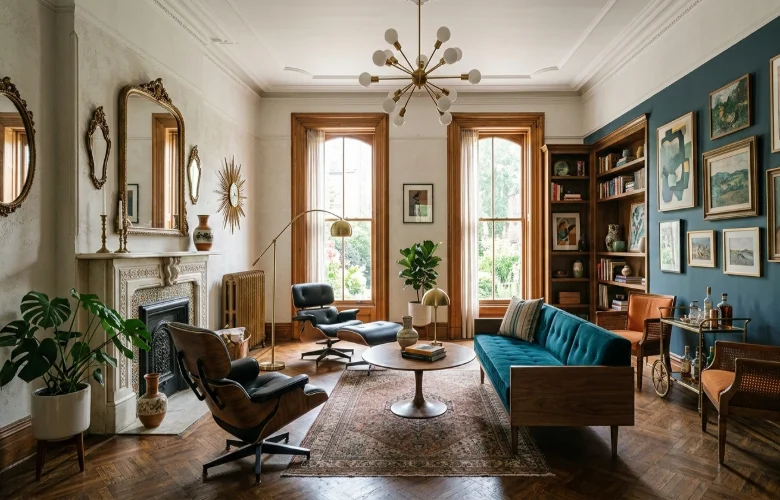
The modern Victorian living room is built around the fireplace as its absolute center. Everything else in the room organizes around it. If your home doesn’t have a working fireplace, a decorative mantel with a mirrored insert creates the same focal point at much lower cost.
Built-in bookshelves flanking the fireplace are among the most sought-after features in Victorian-era homes in the USA, and for good reason. They add storage, display space, and a sense of architectural permanence that freestanding furniture rarely achieves. If original built-ins aren’t present, adding them costs $1,500 to $5,000 depending on size and finish quality, and the transformation is significant.
A velvet sofa in a jewel tone — forest green and burgundy are the most popular choices in 2026 — anchors the seating arrangement. Pair it with a different but complementary armchair in a contrasting texture rather than a matching loveseat. Mix an antique occasional table with a contemporary upholstered ottoman. Keep the room slightly asymmetrical and slightly imperfect. Victorian interiors accumulated over time — they didn’t arrive as coordinated sets.
One large piece of art above the fireplace mantel. A chandelier scaled appropriately to the room. Persian or Turkish rug. Heavy drapes at the windows. These four elements complete the living room’s Victorian character.
Bedroom
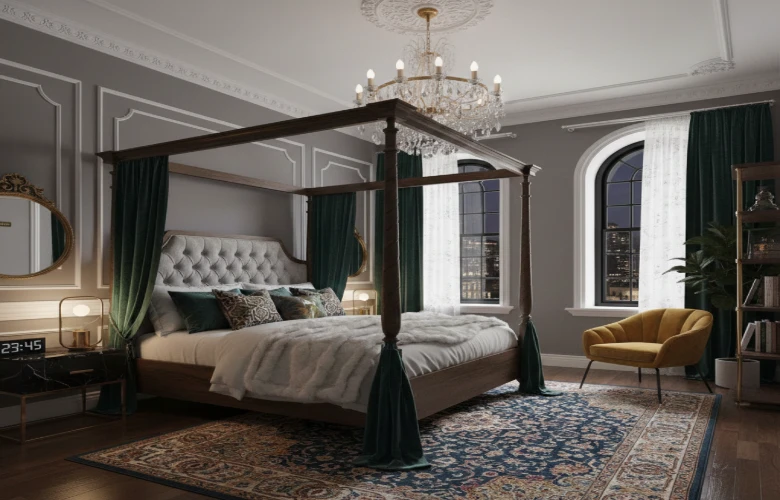
The modern Victorian bedroom is the style’s most intimate application. Deep, saturated colors like forest green, navy blue, deep burgundy, and antique gold create the cocooning quality that Victorian bedrooms are known for, but the modern approach pairs these dramatic elements with softer counterpoints — sage or champagne bedding — to ground the room and keep it feeling restful rather than heavy. Interiordesigntrend
An upholstered headboard in velvet or a curved silhouette that references Victorian architectural arches creates the bedroom’s focal point. An antique brass or gilded mirror above a dresser, a crystal chandelier or period-style pendant above the center of the room, and heavy drapes in a rich fabric complete the atmosphere.
Wallpaper behind the bed is one of the most transformative single decisions in a modern Victorian bedroom. Dark botanical prints, moody floral patterns, or a deep-colored damask on the single wall behind the headboard creates the dramatic backdrop that defines the modern Victorian bedroom without requiring all four walls to be papered.
Dining Room
Victorian dining rooms were designed for ceremony and impression. The modern Victorian dining room takes that intention seriously while making the space work for actual daily meals and entertaining.
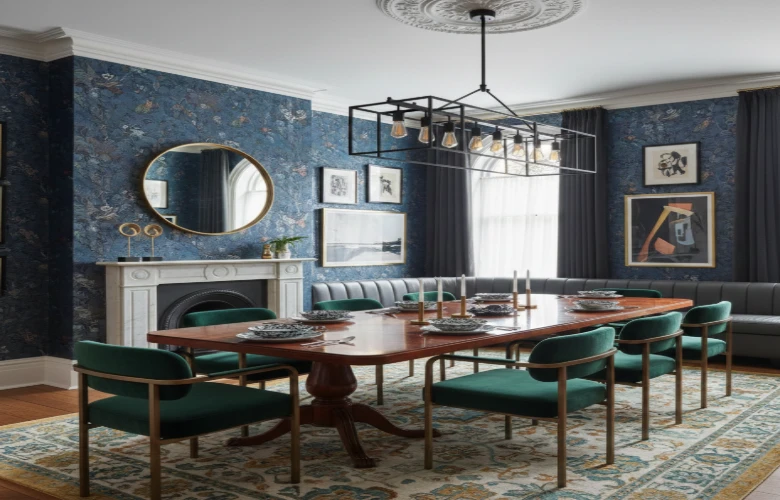
A dark, long dining table in walnut or mahogany with a mix of chairs — not a perfectly matched set — is the foundation. Mix upholstered Victorian-style dining chairs with simpler wooden ones, or combine antique chairs with a contemporary table. The deliberate mixing reads as curated rather than mismatched.
A significant chandelier over the table is non-negotiable. Scale it generously — a fixture that’s 24 to 30 inches in diameter over a table that seats eight or more looks right. Crystal, brass, and dark metal all work.
Deep color on all four walls is most achievable in a dining room because the space is used for specific occasions rather than all-day living. A dining room in Farrow and Ball Hague Blue, Sherwin-Williams Black Magic, or Benjamin Moore Newburyport Blue feels genuinely dramatic and genuinely Victorian in a way that’s extremely difficult to achieve in a room that needs to function across more varied conditions.
Home Office or Study
The Victorian study — the room of leather-bound books, dark wood furniture, and serious intellectual purpose — is experiencing a genuine revival in 2026. With remote work establishing home offices as permanent features of American homes, the study aesthetic has found a new practical purpose.
Floor-to-ceiling bookshelves, a substantial wooden desk, a leather or velvet armchair positioned near a good reading light, and dark walls in a deep green, navy, or warm charcoal create the environment. A globe, a few framed maps or natural history prints, a decanter and glasses on a tray — these accessories complete the Victorian study atmosphere without requiring any of them individually.
The home office is the one room where full Victorian character — dark walls on all four sides, heavy curtains, dark wood furniture throughout — works consistently well in 2026, because the purposeful seriousness of the aesthetic reinforces the serious work that happens there.
How to Add Modern Victorian Character to a Newer Home
Most Americans don’t live in Victorian houses. They live in homes built in the 1950s, 1960s, 1970s, or later, with standard ceiling heights, minimal architectural detail, and no original Victorian features to work with.
Modern Victorian interior design is still completely achievable in these homes with a few specific strategies.
Add architectural detail where there is none. Crown molding, wainscoting, and picture rails can be added to any room. These installations transform the character of generic spaces fundamentally. Crown molding in a living room with 9-foot ceilings immediately elevates the room’s formal quality. Wainscoting in a dining room adds the wall articulation that makes rich colors read as intentional rather than overwhelming.
Invest in a single architectural statement per room. A Victorian fireplace surround installed as a decorative element in a room without a working fireplace. A bay window seat built in to create the projection that Victorian architecture typically featured. A ceiling medallion installed at the center of a room to frame a period-appropriate chandelier. Each of these can be executed in existing homes without structural renovation.
Let textiles and furniture carry the Victorian character. In rooms where architectural modification isn’t feasible, rich textiles and appropriately scaled furniture do the heavy lifting. A velvet sofa, heavy drapes, a Persian rug, and a crystal chandelier create the Victorian atmosphere in a room with completely plain walls and standard proportions.
Use color strategically. Painting woodwork in a solid, unexpected hue — like mustard yellow covering both paneling and trim — creates a warm, enveloping backdrop that is distinctly Victorian in spirit even in completely contemporary architectural contexts. Interiordesigntrend
Modern Victorian Interior Design Cost Breakdown
| Approach | Cost Estimate | What It Achieves |
|---|---|---|
| Textile and accessory update | $1,000 to $5,000 | Velvet sofa, drapes, rug, chandelier swap |
| Architectural addition | $3,000 to $15,000 | Crown molding, wainscoting, picture rail, fireplace surround |
| Full room renovation | $15,000 to $40,000 | New millwork, wallpaper, built-ins, quality furniture |
| Whole home Victorian renovation | $40,000 to $150,000+ | Complete architectural and interior transformation |
The highest-ROI single investment in a modern Victorian interior is almost always the lighting fixture. A quality chandelier in an appropriately scaled size transforms the character of a room more completely than any furniture purchase of the same cost, because it affects the quality of every other element in the room.
Understanding what interior designers charge for projects with significant millwork, antique sourcing, and custom drapery helps set expectations for the professional services component of a Victorian renovation, which tends to be higher than for more straightforward contemporary projects.
Modern Victorian vs. Related Styles
| Style | Key Difference from Modern Victorian |
|---|---|
| Traditional | Traditional design uses historical references earnestly for refinement. Modern Victorian is more theatrical, more willing to use dark drama. Both value craftsmanship and quality textiles. |
| Maximalist | Maximalism embraces abundance without historical reference. Modern Victorian has specific cultural roots. Maximalism can use any material palette. |
| Gothic | Gothic design shares Victorian design’s darkness and drama but leans into medieval and ecclesiastical references specifically. Modern Victorian has broader cultural sources. |
| Bohemian | Bohemian is globally eclectic and culturally non-specific. Modern Victorian is anchored in a specific cultural period and geographic tradition. Both layer richly. |
| Modern Classic | Modern classic is more formal and symmetrical. Modern Victorian is more theatrical and moody. Both use quality materials and historical reference. |
| Rustic | Rustic uses raw natural materials for warmth. Modern Victorian uses refined, worked materials for richness. Both resist generic contemporary design but for entirely different reasons. |
Common Modern Victorian Mistakes
Using too many dark colors simultaneously. A dining room in deep green is beautiful. A home where every room features a different deep jewel tone without neutral relief becomes oppressive. Use strong color in specific rooms and specific applications, not throughout the entire home at the same saturation level.
Buying furniture that matches too perfectly. Victorian interiors were accumulated over time, not purchased as sets. Matching sofas and loveseats, perfectly coordinated dining chair sets, and furniture suites that come from the same collection undermine the collected, personal quality that modern Victorian design depends on.
Over-accessorizing. The Victorian era did practice a form of maximalism, but thoughtless accumulation produces clutter rather than richness. Every object in a modern Victorian interior should be genuinely beautiful or genuinely meaningful. Generic decorative objects that exist purely to fill space work against the style’s values.
Ignoring lighting quality. Poor lighting is the fastest way to make a dark Victorian room feel oppressive rather than moody and rich. Layered warm-toned lighting at multiple heights, with particular attention to the quality of light on textured surfaces and detailed millwork, is essential.
Treating the style as exclusively formal. Modern Victorian design works in living rooms that people actually relax in, bedrooms that people actually sleep in, and kitchens where people actually cook. The style’s comfort and livability depend on choosing upholstery and materials that hold up to real use rather than display-only pieces.
Frequently Asked Questions
What is modern Victorian interior design?
It is a style of design which combines traditional Victorian features with streamlined designs and comfortability. It preserves old-fashioned beauty and maintains the normal lifestyle.
What is the 3–5–7 rule in interior design?
This principle proposes odd numbers in setting decor together. It establishes aesthetic harmony and makes spaces appear natural.
How can a modern home look more Victorian?
Incidentals such as adding molding, vintage lighting, patterned fabrics, and luxurious furniture bring the Victorian flair to the Modern environment.
What is the 70/30 rule in interior design?
This rule implies one style has to prevail, and the second style should be in favor of it. This maintains space equilibrium and order.
What are the three F’s of interior design?
They represent functionality, circulation and tact. These principles assist in building good and efficient spaces.
What is mid century modern Victorian interior design?
Mid century modern Victorian interior design is a style that incorporates the Victorian ornamental information in the simplicity and functionality of the mid century modern furniture. It combines both old and new architectural pieces in a harmonious and classical interior.
Conclusions about developing an immortal house
Design must help in the way people live. Houses ought to be cozy, intimate and permanent.
Modern victorian interior design is a considered answer to the American homeowners by combining the traditional beauty with the Modern demands. It provides spaces which are beautiful now and are applicable tomorrow.