Last Updated on 5 months ago by
You’ve got a small living room and you want it to actually feel good. Not just okay for the size genuinely comfortable, put-together, and worth spending time in.
The problem is most guides on small living room ideas show you polished photos and skip everything useful. No real costs. No layout math. No honest talk about what happens when you bring that sofa home and it doesn’t fit.
This guide is different. You’ll get tested small living room ideas across every angle TV placement, budget setups, IKEA picks, modern looks, and how to squeeze in a dining table without losing your mind. Real prices. Practical advice. Nothing padded.
Before anything else: measure your room before you buy anything. Write the dimensions on paper. Know your square footage. Sketch a rough floor plan. Every decision below gets easier once you have those numbers.
Small Living Room Layout Ideas That Don’t Waste Space
Layout is the foundation. Get this wrong and even expensive furniture looks off. Get it right and a $600 IKEA setup can look intentional and well-designed.
The biggest layout mistake in small rooms is pushing every piece of furniture against the walls. It feels logical. It doesn’t work. When everything lines the perimeter, the room reads as awkward like chairs at a formal event where nobody wants to sit down.
Pull your sofa 6 to 8 inches away from the wall behind it. That gap creates breathing room. The eye reads the seating area as a defined zone rather than stuff shoved to the edges. It works in rooms as small as 10 by 12 feet.
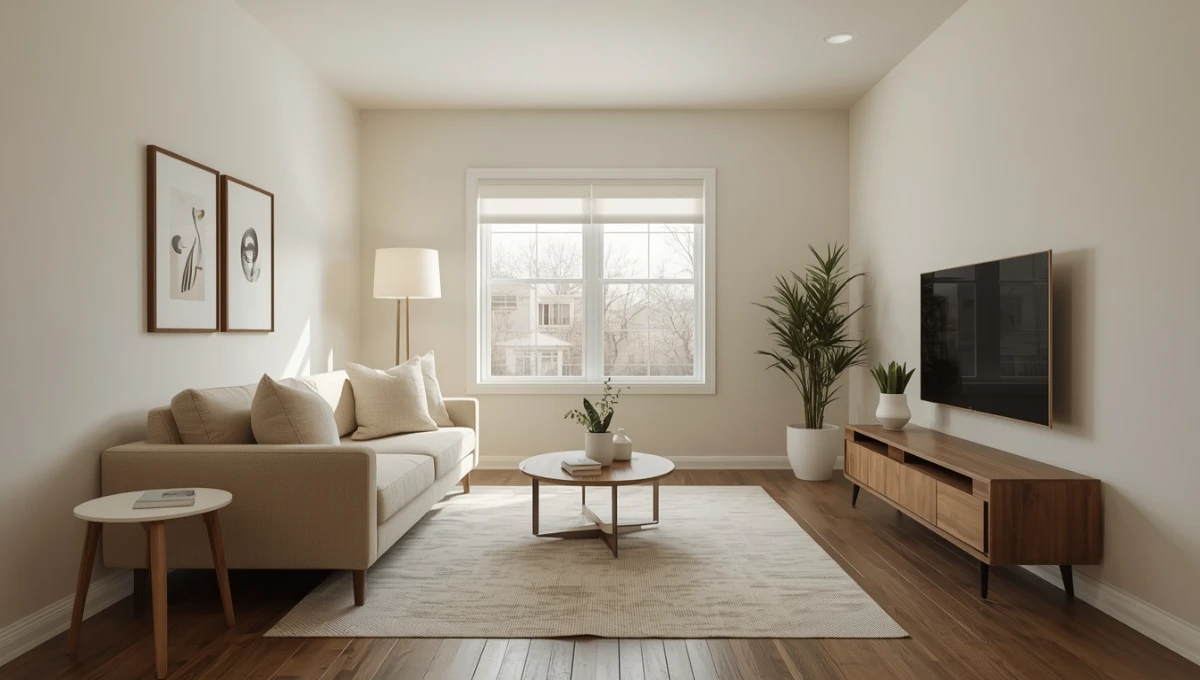
For rooms under 180 sq ft, the layout that consistently works is: one sofa (72 inches max) facing the TV wall, one armchair at an angle, and a small coffee table or pair of nesting tables in the middle. No matching side tables on both ends. No oversized entertainment center. Just the pieces that earn their spot.
Walking paths matter too. You need at least 30 inches of clear space to move through a room comfortably. 24 inches is the absolute minimum. Get a roll of painter’s tape and map out your planned furniture on the floor before spending anything. Move through it. Open imaginary drawers. Check the door swing. This takes 20 minutes and saves a lot of expensive regret.
If your room is long and narrow what designers sometimes call a bowling alley shape place the sofa along the long wall, not across the short end. Use a runner rug to define the space and two chairs facing the sofa instead of a loveseat. It keeps the room from feeling like a hallway with furniture.
Small Living Room Ideas With TV That Don’t Look Awkward
The TV is the most common design headache in small living rooms. It’s a large dark rectangle that dominates whatever wall it’s on. The goal isn’t to hide it it’s to make it look like a choice rather than an afterthought.
Wall mounting is the most space-efficient option. A basic tilting TV wall mount costs $25 to $45 at Home Depot or Lowe’s. It frees up floor space, removes the visual bulk of a console, and lets you position the screen at the right height. Eye level when seated is the target roughly 42 to 48 inches from floor to center of screen for most couches.
If you mount the TV, deal with what surrounds it. A blank wall with a floating screen looks unfinished. Two small floating shelves on either side, holding books, a plant, and one or two objects, give the eye somewhere to land. You’re not decorating a gallery just breaking up the black rectangle.
If you’d rather keep a console, go narrow and low. IKEA’s BESTÅ system lets you configure exactly the width and height you need. A 47-inch wide, 15-inch tall BESTÅ unit runs about $150 to $280 depending on doors and drawers. It holds the TV without eating the visual space a 60-inch media cabinet does.
Corner placement works well in L-shaped rooms or rooms where no wall is quite right. An angled corner TV mount ($30 to $60) lets you point the screen toward the seating area without dedicating an entire wall to it. In a 12 by 12 room, this frees up significant wall space for shelving or a large mirror on the main walls.
One thing most guides skip: your viewing distance matters. For a 55-inch TV, you want to sit at least 7 feet away. For a 65-inch screen, you need about 8 feet. If your room is only 10 feet deep, a 55-inch is the right call, not a 75-inch just because they’re on sale.
Modern Small Living Room Ideas That Don’t Look Cheap
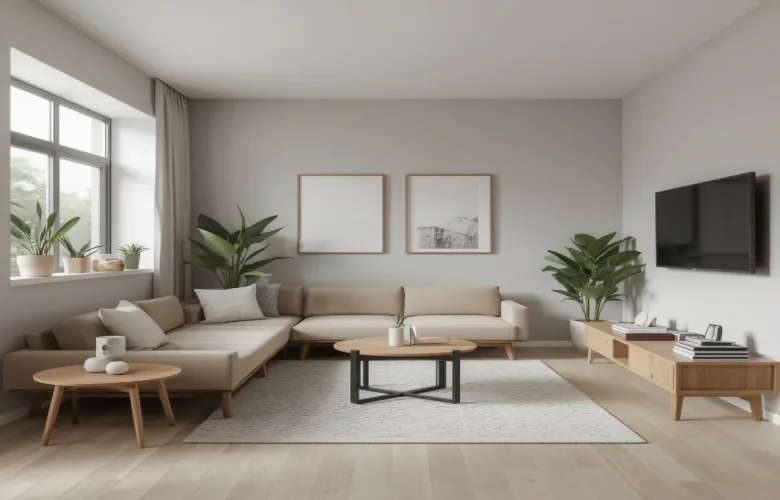
Modern design in a small room comes down to three things: fewer pieces, better quality on the ones you keep, and consistency in materials.
Pick one or two materials and stick with them. If your sofa has walnut legs, get a coffee table with walnut or similar warm wood. If you go with a white and gray palette, keep your accents in that family. Mixing five different wood tones and three different metal finishes in 150 sq ft reads as chaotic no matter how nice the individual pieces are.
Warm neutrals work better in small rooms than stark white. Benjamin Moore White Dove (OC-17) or Sherwin-Williams Accessible Beige (SW 7036) give you a clean modern base that still feels livable. Pure white walls in a small room can look cold and institutional, especially with limited natural light.
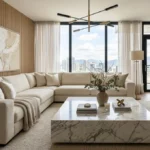
For a modern look at a real price: a light-colored linen or boucle sofa, a simple round coffee table in natural wood, one quality floor lamp, and a large neutral rug. That combination holds up over time. Article’s Sven sofa ($899) in light gray or natural linen hits this look cleanly without looking like a showroom.
Floating shelves instead of full bookcases keep the modern look clean. Two or three shelves staggered on one wall, holding a mix of books, plants, and a few objects, add personality without the visual weight of a floor-to-ceiling unit. IKEA’s BERGSHULT shelf with PERSHULT brackets runs about $40 to $60 per shelf and holds up well.
Small Living Room Ideas on a Budget That Still Look Good
Budget doesn’t mean bad. It means strategic. Here’s where to spend and where to save.
Spend more on the sofa. It’s the piece you use every day and the one that dates a room fastest when the quality is low. A $399 IKEA KIVIK in good condition looks fine. A $199 Amazon sofa with thin cushions looks cheap within six months. The sofa is not where to cut corners.
Save on accent pieces. Side tables, throw pillows, baskets, and small decorative items don’t need to be expensive. Target, TJ Maxx, and HomeGoods carry solid options at real prices. A $12 throw from Target and a $25 plant from a local nursery do more for a room’s warmth than a $200 decorative vase.
Here’s a realistic cost breakdown for a functional small living room:
Budget setup, under $900: Sofa from IKEA KIVIK or EKTORP, $399 to $599. Coffee table or storage ottoman from Target, $79 to $129. Rug (6×9) from Home Depot, $79 to $149. Floor lamp from Target or Wayfair, $45. Two curtain panels from IKEA, $20 to $40. Total: $622 to $962.
Mid-range setup, $1,500 to $2,200: Sofa from Article or West Elm, $899 to $1,200. Storage ottoman from Wayfair, $120 to $180. Rug (8×10) from Ruggable or Lowe’s, $179 to $249. Nesting tables from CB2 or World Market, $80 to $150. Lighting, $80 to $150. Curtains from West Elm, $80 to $160. Total: $1,438 to $2,090.
The mid-range setup delivers roughly 85% of the visual result at about 40% of an investment-level cost. Start there and upgrade individual pieces over time rather than trying to do everything at once.
One budget tip most guides miss: buy your rug before you buy furniture. The rug sets the size of your seating area and determines how much sofa, table, and chair can realistically fit. Getting the rug first saves you from the expensive mistake of buying pieces that don’t work together spatially.
Small Living Room Ideas IKEA Picks That Actually Hold Up
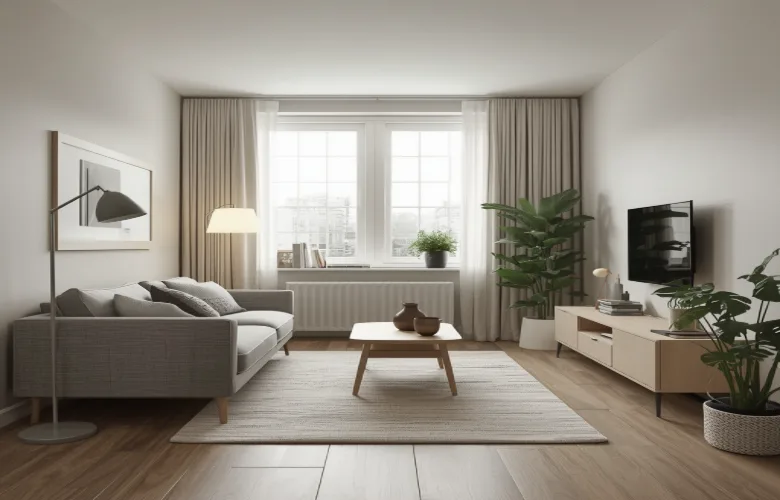
IKEA gets a mixed reputation for quality, and some of it is earned. But for small spaces specifically, the modular systems are hard to beat when you know which pieces are worth it.
The KALLAX shelving system is one of the most useful pieces IKEA makes. A 2×4 KALLAX unit ($79) can work as a TV console, a room divider, or a storage wall. Add DRONA fabric boxes ($7 each) to hide clutter. Stack two units vertically for floor-to-ceiling storage in a 12-inch footprint.
The BESTÅ TV storage system is fully configurable with clean lines and good door options to hide everything inside. A basic 47-inch unit starts at $150. Add legs to lift it off the floor for a more current look.
BILLY bookcases at $49 to $129 are solid for lighter loads paperbacks, plants, and decorative objects. The particleboard bows under very heavy books over time, but for everyday use they hold up fine for years.
IKEA sofas are fine for occasional use or guest rooms. For a main sofa in a room you use daily, go with the KIVIK or ÄPPLARYD over the base EKTORP. Both hold their shape better with regular use, especially with a performance fabric cover.
Skip IKEA floor lamps in the lower price range. The HEKTAR and RANARP both look good in product photos but feel flimsy when you handle them in store. Spend $45 to $80 at Target or Wayfair for a lamp that actually feels solid.
For paint, skip IKEA entirely. Sherwin-Williams or Benjamin Moore are worth the extra $15 to $30 per gallon. The coverage and durability difference is real, especially on colored walls.
Small Living Room Ideas With Dining Table Making Both Fit
This is the question that doesn’t get answered well anywhere: how do you fit a living room and a dining area in the same small space without it looking like a storage unit?
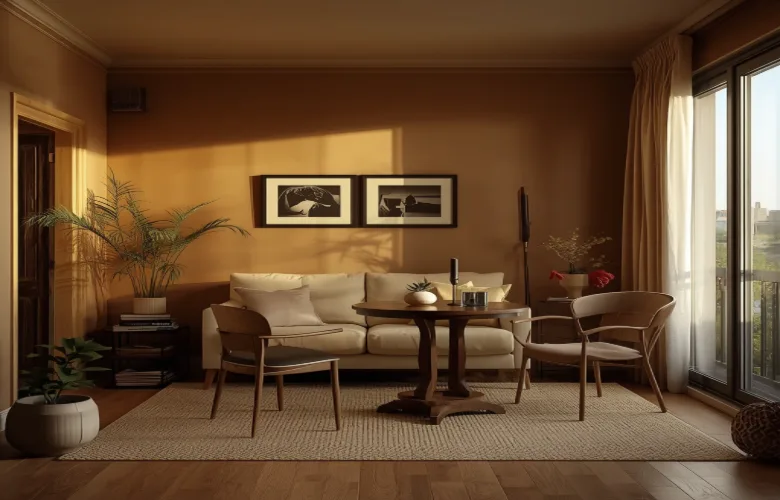
The answer is zoning. Two distinct areas, each with their own anchor, connected by a shared color palette. The rug defines the living zone. The dining table defines the eating zone. A clear walkway between them at least 30 inches makes both areas feel intentional rather than crammed.
For the dining table in a small combo space, round beats rectangular. A round table seats four in less floor space than a 36 by 60-inch rectangle, and no corners cut into the walking path. IKEA’s LISABO round table at $179 seats two to four and works in tight spaces. The INGATORP extends from 35 to 51 inches for when you have guests.
Extendable tables are the smartest purchase you can make in a small combo space. Keep it compact for daily use, extend it when people come over. West Elm’s extendable dining tables start around $399. CB2 carries solid options in the $299 to $499 range.
Position the dining table near the kitchen if possible, away from the main seating area. If that’s not an option, place it behind the sofa with a narrow console table acting as a visual divider. That 10 to 14-inch console table behind the couch does double duty it separates the two zones and gives you a surface for a lamp or a plant.
Foldable chairs make a real difference. Chairs that fold flat and hang on a wall or slide under a shelf keep the dining area from eating the room when not in use. IKEA’s TERJE folding chair at $30 each is functional and easy to store. HAY’s Rel Chair folds thin and looks good against a wall at $79 each.
If your space is under 200 sq ft and needs both a TV and a dining area, this layout consistently works: sofa facing the TV wall, dining table behind the sofa with a slim console table between them, one rug under the sofa and coffee table, and a second smaller rug or bare floor under the dining area. Two zones, one room, clear separation.
FAQ: Small Living Room Ideas
What is the best layout for a small living room?
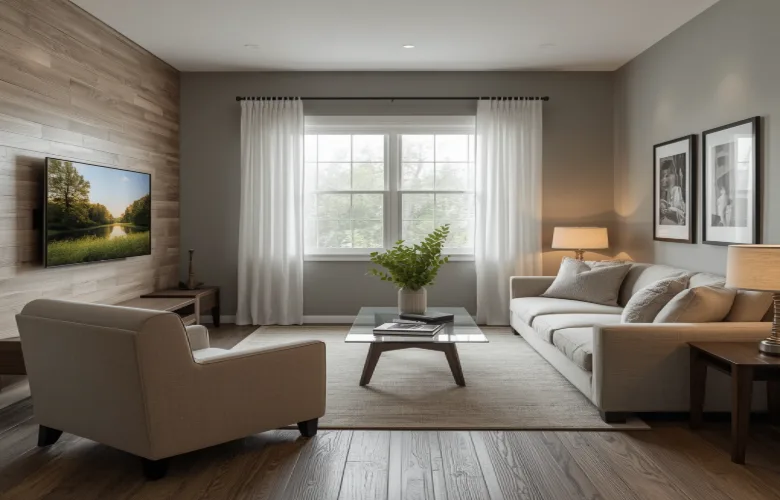
The best layout keeps furniture pulled slightly off the walls and maintains at least 30 inches of walking space between pieces. For most rooms under 200 sq ft, one sofa facing the main wall, one armchair at an angle, and a small coffee table in the center works well. Avoid sectionals, oversized entertainment centers, and matching furniture sets that fill every corner. If you want to see how different room shapes affect the layout, the guide to apartment living room setups on Interior Design Trend covers studio and one-bedroom configurations in detail.
How do I place a TV in a small living room?
Mount the TV on the wall at eye level when seated, roughly 42 to 48 inches from floor to screen center. A basic tilting mount costs $25 to $45 at Home Depot. Add two small floating shelves on either side to frame the screen. If you want a console instead, keep it low and narrow under 20 inches tall and close to your sofa width.
What IKEA furniture works best in small living rooms?
What IKEA furniture works best in small living rooms? The KALLAX shelving system, BESTÅ TV storage, and BILLY bookcases are the most useful pieces for small spaces. They’re modular and consistently available. For sofas, the KIVIK and ÄPPLARYD hold up better than budget options for daily use. Skip IKEA floor lamps in the lower price range and buy from Target or Wayfair instead.
How do I fit a dining table in a small living room?
Choose a round or extendable table and keep it on the kitchen side of the room. Place it behind the sofa with a slim console table as a zone divider. Use foldable chairs that store flat when not needed. A 6×9 rug under the sofa area and a smaller rug or bare floor under the dining area helps both zones read as separate without feeling disconnected.
What colors make a small living room look bigger?
Warm whites like Sherwin-Williams Alabaster (SW 7008) or Benjamin Moore White Dove (OC-17) work well in small rooms. Paint the ceiling the same color as the walls or one shade lighter to add perceived height. One dark accent wall behind the sofa creates depth and makes the room feel longer. Avoid painting all four walls in a saturated dark color it compresses the space even when the square footage hasn’t changed. For color ideas by room style, the paint color guide on Interior Design Trend breaks down what works in modern, minimal, and transitional spaces.